
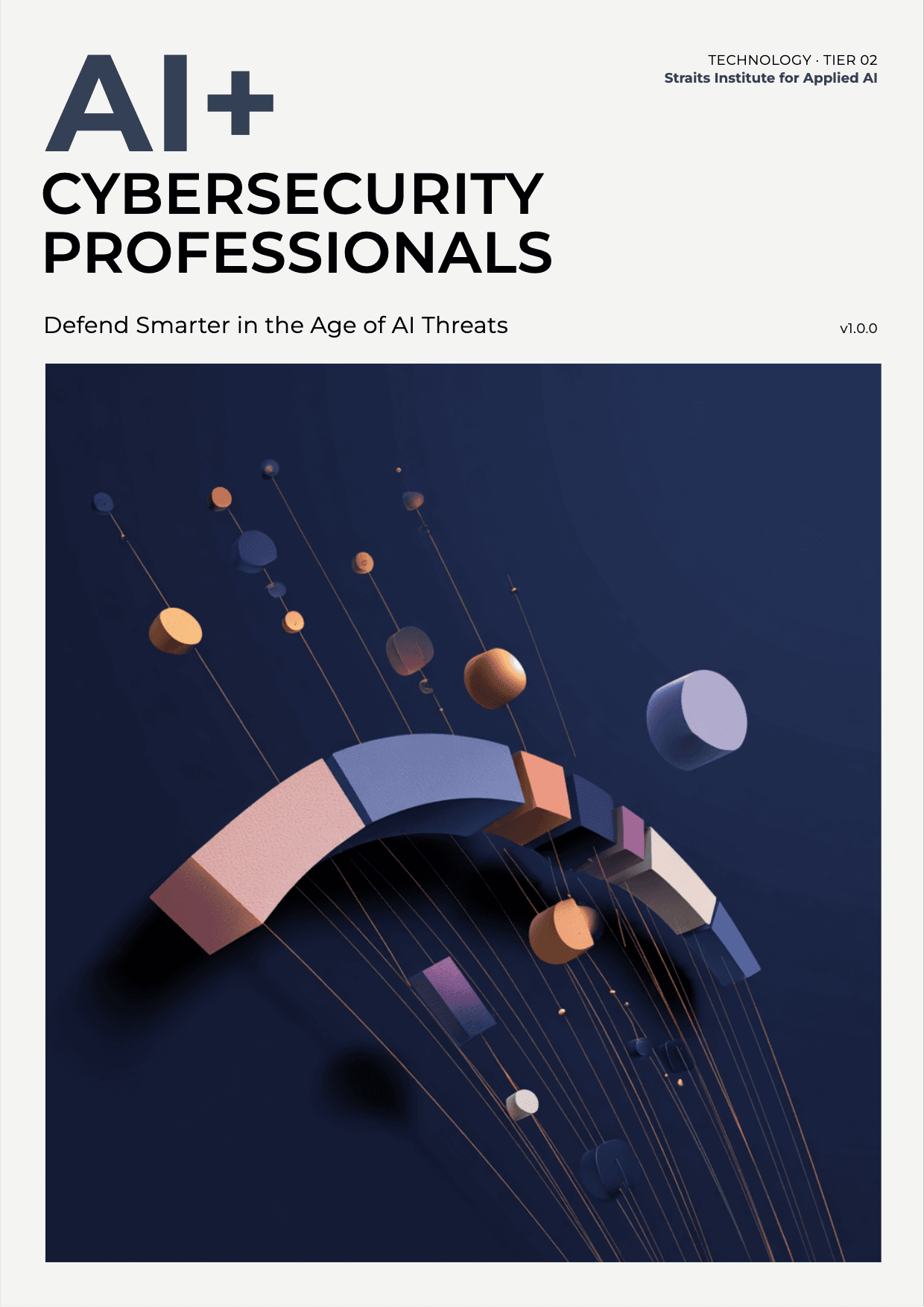
AI+ Cybersecurity Professionals
Defend Smarter in the Age of AI Threats
Defend better. Defend smarter. Defend without leaking.
Your SIEM queue is full, the board wants an AI posture by Tuesday, and attackers are already using the tools you've been cautious about. This book gives cybersecurity professionals a working practice: the DEFEND Protocol for data classification, 30 ready-to-run prompts across detection, intelligence, vulnerability, and governance work, and a 30-day plan tailored to your role. Written by AI+ Institute, reviewed with practising SOC and CISO leaders.
- 30 ready-made, market-tested prompts: alert triage, detection rationale, threat intelligence, vulnerability prioritisation, incident reports, board briefings
- The DEFEND Protocol — six-category framework for Detection logic, Exploit intelligence, Forensic data, Exposed surface, Named threat attribution, Dual-use AI risk
- AI-specific threat coverage — prompt injection, training data exposure, deepfake social engineering, adversarial ML, shadow AI across the workforce
- A sanitisation discipline at every prompt — what to strip before any external AI tool sees it
- A 30-day plan for SOC analysts, detection engineers, threat intelligence analysts, vulnerability managers, security architects, and CISOs
Cybersecurity professionals with direct accountability for protecting information, systems, and people in digital environments. Typical titles: SOC Analyst (Tier 1/2/3), Security Engineer, Security Architect, Threat Intelligence Analyst, Incident Responder, Detection Engineer, Security Operations Manager, Chief Information Security Officer (CISO), Information Security Manager, Penetration Tester, Red Teamer, Purple Teamer, Vulnerability Manager, GRC Analyst (security-focused), Cloud Security Engineer. Two to fifteen years of professional cybersecurity experience. Works across sectors: financial services, healthcare, government, technology, energy, critical national infrastructure, retail, professional services, and defence. Daily work spans: detecting and responding to alerts, investigating incidents, managing vulnerabilities, hunting for threats, producing threat intelligence, drafting security policies, communicating risk to non-technical leadership, and governing the organisation's security tooling estate.
Also for:Senior IT professionals transitioning into security roles. IT managers with formal security responsibilities in smaller organisations (the "accidental CISO"). Security consultants and external advisors. Audit and compliance professionals with security remit (forward-reference T2-19 for depth). Junior analysts preparing for progression.
- Apply the Cybersecurity Prompt Toolkit to at least six recurring cybersecurity tasks — including alert triage narrative, detection rule drafting, threat intelligence summary, vulnerability prioritisation, incident report, and stakeholder communication — producing professional-standard outputs materially faster
- Apply the DEFEND Protocol to classify cybersecurity data before any AI interaction — correctly identifying which categories require organisation-approved tools only and which must never enter any AI tool
- Identify at least five AI-specific threat categories — including prompt injection, training data exposure, deepfake-enabled social engineering, adversarial ML, and shadow AI use — and apply an appropriate defensive response to each
- Draft an AI-assisted incident report, a detection rule rationale, and a security risk register entry, each evaluated with TRUST before use
- Design a personal 30-Day Cybersecurity AI Starter Plan identifying at least three quick-win AI applications in their specific security function
- Diagnostic
- How AI-ready is your cybersecurity work?
- Chapter 1
- AI in Cybersecurity Right Now
- Chapter 2
- What AI Can (and Cannot) Do in Cybersecurity
- Chapter 3
- Prompting AI for Cybersecurity Work
- Chapter 4
- Detection, Response and the SOC
- Chapter 5
- Threat Intelligence and Threat Hunting
- Chapter 6
- Vulnerability and Exposure Management
- Chapter 7
- AI-Specific Threats and Defences
- Chapter 8
- Cybersecurity Governance and Reporting
- Chapter 9
- AI Safety for Cybersecurity Professionals
- Chapter 10
- Your 30-Day Cybersecurity AI Starter Plan
- Back matter
- Skill Summary · Recommended Next Reads · Glossary · Tool Reference
Built by an AI engineering firm — for cybersecurity professionals who use AI to defend without becoming an exposure surface themselves.
Often read alongside this title.
 T2-26 · Job RolesAI+ Software Developers
 T2-27 · Job RolesAI+ IT Managers
 T2-29 · Job RolesAI+ Data Analysts
 T2-30 · Job RolesAI+ Product Managers
 T2-88 · Job RolesAI+ Data Scientists
 T2-127 · Job RolesAI+ QA and Test Engineers
 T2-128 · Job RolesAI+ Cloud Architects & DevOps Engineers
 T2-129 · Job RolesAI+ AI/ML Engineers