
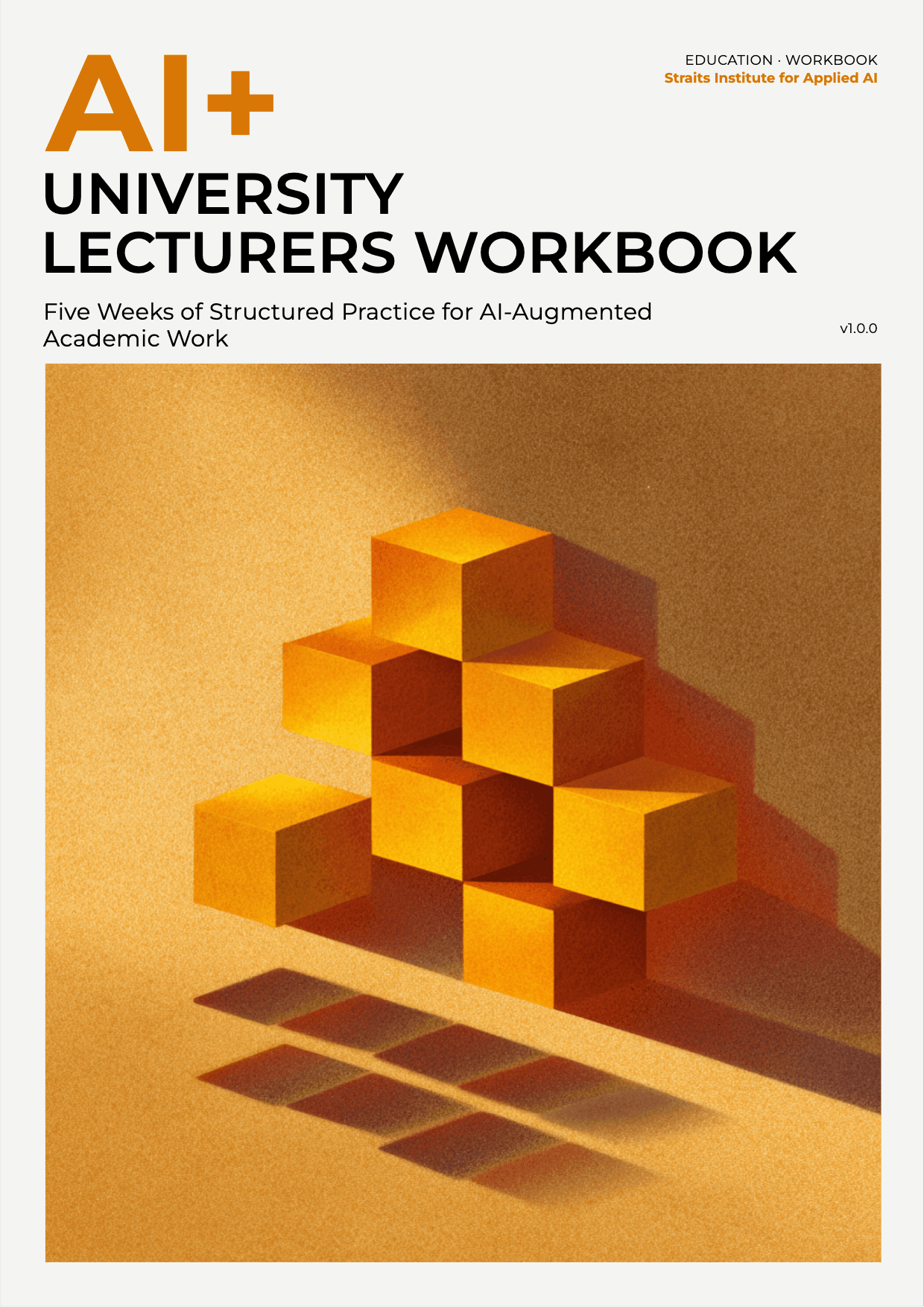
AI+ University Lecturers Workbook
Practice companion to AI+ University Lecturers
Practice companion to T2-13.
You know the frameworks. Your grant section is still a blank page.
You've read the frameworks. Your grant section is still a blank page and your most AI-vulnerable assessment brief hasn't changed. This five-week workbook turns the Academic Task-AI Map, PRISM, TRUST, PACE, and the RISE Academic AI Safety Protocol into your actual practice — a real literature synthesis, a redesigned assessment brief, a completed RISE audit, and a 30-Day Academic AI Starter Plan built from what you've already done. Built by an AI engineering firm for academics who know the theory — and need the habit.
- 48 structured exercises across five weeks — one per real academic task, not a theory recap
- Weeks 1–2 — capability and writing: PRISM prompts, TRUST checks, verified literature syntheses, grant sections
- Week 3 — teaching and engagement: lecture and seminar design, feedback at scale, supervision practice
- Week 4 — assessment integrity: a full PACE redesign of a real assessment brief, plus a policy statement
- Week 5 — ethics and strategy: a RISE Protocol audit, a disclosure statement, and a 30-Day Academic AI Starter Plan
A university or higher education lecturer, senior lecturer, associate professor, or professor who has read (or is working through) AI+ University Lecturers (T2-13) and wants structured, progressive practice to turn its frameworks into a working academic habit. They are not looking for more explanation of what AI can do for research, teaching, or administration — they want to draft the real grant section, redesign the real assessment brief, and run the real RISE audit against their own research project.
Also for:A department or faculty running the workbook as a shared practice arc ahead of an academic year; a PhD supervisor group or early-career academic development cohort using it as a structured onboarding programme; an academic development or CPD lead using it as a facilitated departmental programme.
- Produce AI-assisted literature syntheses, grant sections, and administrative documents using the Academic Task-AI Map and PRISM Prompting Framework, and evaluate each output against the TRUST Framework — including independently verifying every AI-suggested citation — before it is used
- Design and deliver AI-assisted teaching materials and student feedback at scale, applying PRISM to lecture structures, seminar questions, case studies, and formative/summative feedback while maintaining personalisation
- Apply the PACE Framework to redesign at least one real assessment brief for AI resilience, drafting the Permission, Authenticity, Continuity, and Equity elements against a real module
- Complete a RISE Academic AI Safety Protocol audit of your own research, teaching, supervision, and administrative AI use, and draft a disclosure statement for a real research output
- Build and commit to a personalised 30-Day Academic AI Starter Plan that draws on the artefacts produced across Weeks 1–4
- Week 1
- Your Academic Task-AI Map and Your First Prompts
- Week 2
- Your Scholarly and Administrative Writing
- Week 3
- Teaching Design and Student Engagement
- Week 4
- Assessment and Academic Integrity
- Week 5
- AI Safety, Research Ethics, and Your Academic AI Strategy
- Back matter
- Skill Summary · Recommended Next Reads · Glossary · Tool Reference
Built by an AI engineering firm for academics who know the frameworks — and need the habit of running them before the next exam board.
Often read alongside this title.
 T2-80 · Job RolesAI+ Educators
 T2-11 · Job RolesAI+ School Teachers
 T2-141 · Job RolesAI+ Primary School Teachers
 T2-12 · Job RolesAI+ School Leaders
 T2-13 · Job RolesAI+ University Lecturers
 T2-133 · Job RolesAI+ TVET Instructors
 T2-134 · Job RolesAI+ TVET College Leaders
 T2-135 · Job RolesAI+ Apprenticeship Managers