
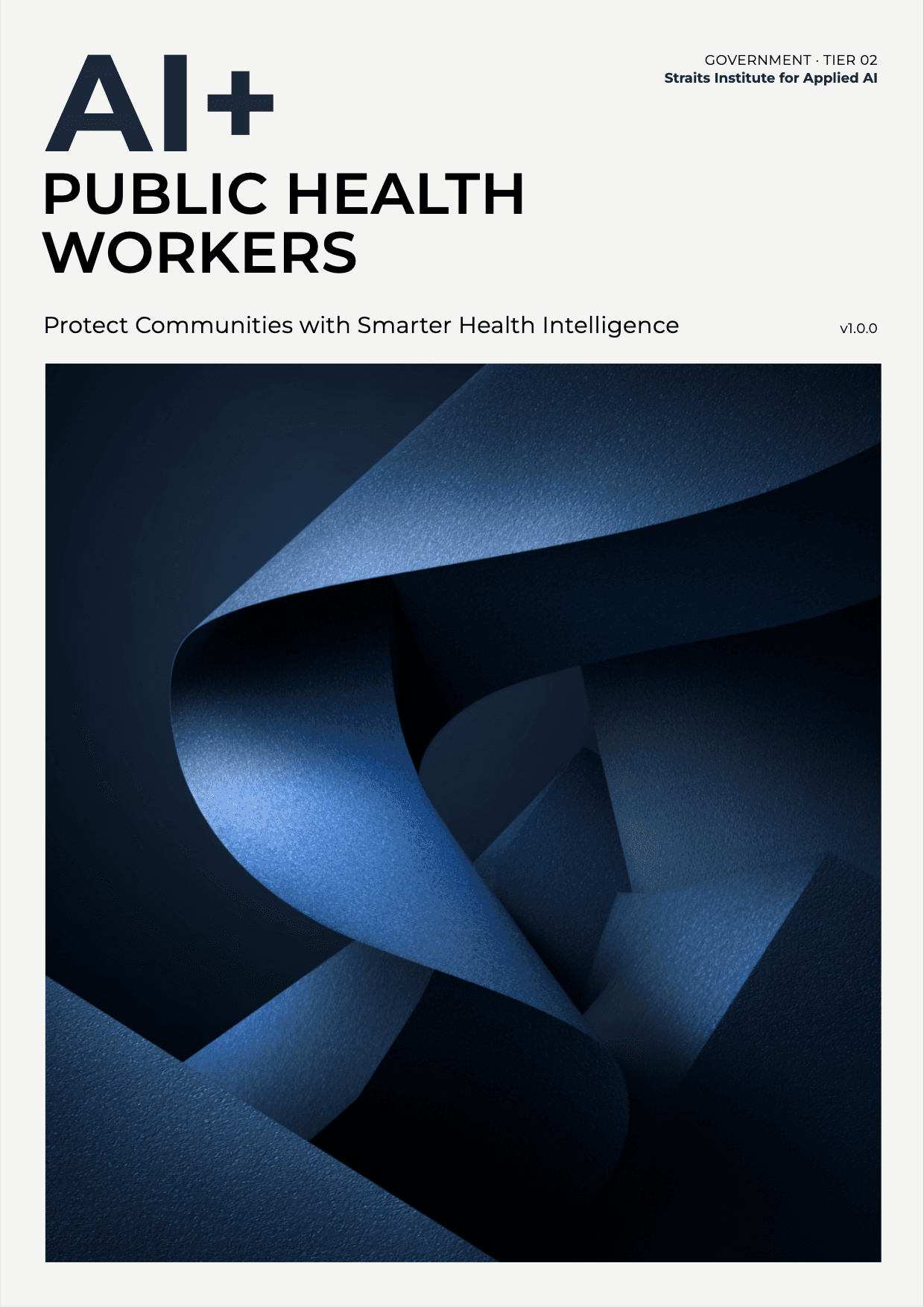
AI+ Public Health Workers
Protect Communities with Smarter Health Intelligence
Faster bulletins. Equity-aware messaging.
You're an epidemiologist producing the same surveillance bulletin for the fourth year running. A health needs assessment looms. Community communications need to reach three communities, not one. AI can compress the drafting, synthesise the evidence, and adapt the message — but only if you know where the professional lines are. AI+ Public Health Workers gives you two new frameworks (the VITAL Protocol for population health data safety, the Equity Review Cycle for community communications), 28 copy-ready prompt templates, and the discipline to use AI at the speed public health actually demands.
- 28 ready-made, market-tested prompts: surveillance reporting, outbreak comms, community messaging, HNA drafting, equity review
- The SIGNAL Protocol — public health AI safety covering population data, surveillance integrity, and IHR obligations
- The Equity Review Cycle — four-step check that catches health-disparity bias in community communications
- A surveillance bulletin workflow that turns half a day into ninety minutes
- A 30-day plan that fits a national institute, regional authority, district office, or field role
Public health workers in government health agencies at national, regional, and local levels. Typical titles: Epidemiologist, Public Health Officer, Disease Surveillance Officer, Health Promotion Officer, Environmental Health Officer, Outbreak Response Coordinator, Health Intelligence Analyst, Community Health Worker. 2–15 years in post. Science or public health degree; many have postgraduate qualifications (MPH, MSc Epidemiology). They sit at the intersection of data, policy, community, and health. They work within government structures but have specialist technical autonomy. Most are not clinicians and do not hold clinical registration. Their work spans routine surveillance reporting, outbreak investigation, health needs assessment, programme evaluation, and community health communication.
Also for:Environmental health officers with disease investigation responsibilities; public health programme managers; health promotion specialists in NGOs and international organisations; field epidemiology trainees (FETP); health data analysts in government health ministries; public health registrars and residents in training.
- Use AI to accelerate disease surveillance reporting and outbreak signal detection, applying the VITAL Protocol to protect surveillance system integrity and population health data privacy
- Draft public health reports, policy briefs, and health needs assessments with AI assistance while maintaining the evidence rigour required in formal public health advice
- Produce community health communications adapted to diverse literacy levels and cultural contexts using AI, applying the Equity Review Cycle to every community-facing output
- Apply the VITAL Protocol before any AI interaction involving population health data, surveillance datasets, or pre-decisional outbreak intelligence
- Complete a 30-day personal AI adoption plan tailored to their specific public health role and deployment context
- Diagnostic
- How AI-Ready Is Your Public Health Practice?
- Chapter 1
- AI in Public Health Right Now
- Chapter 2
- What AI Can (and Cannot) Do for Public Health Work
- Chapter 3
- How to Prompt AI for Public Health Tasks
- Chapter 4
- AI for Surveillance Reporting and Data Narratives
- Chapter 5
- AI for Outbreak Response and Situation Reports
- Chapter 6
- AI for Health Needs Assessments and Policy Briefs
- Chapter 7
- AI for Community Health Communications
- Chapter 8
- AI Safety, Data Privacy, and Public Health Ethics
- Chapter 9
- Building an AI Practice in Public Health Work
- Chapter 10
- Your 30-Day Public Health AI Starter Plan
- Back matter
- Skill Summary · Recommended Next Reads · Glossary · Tool Reference
Built by an AI engineering firm — for public health workers who serve communities, not abstractions.
Often read alongside this title.
 T3-97 · Job SkillsAI+ Case Management
 T2-41 · Job RolesAI+ Civil Servants
 T2-70 · Job RolesAI+ Public Service Leaders
 T2-43 · Job RolesAI+ Policy Makers
 T2-42 · Job RolesAI+ NGO Leaders
 T2-87 · Job RolesAI+ Foreign Service Officers & Diplomats
 T2-117 · Job RolesAI+ Consular Officers
 T2-118 · Job RolesAI+ Trade and Commercial Attachés