
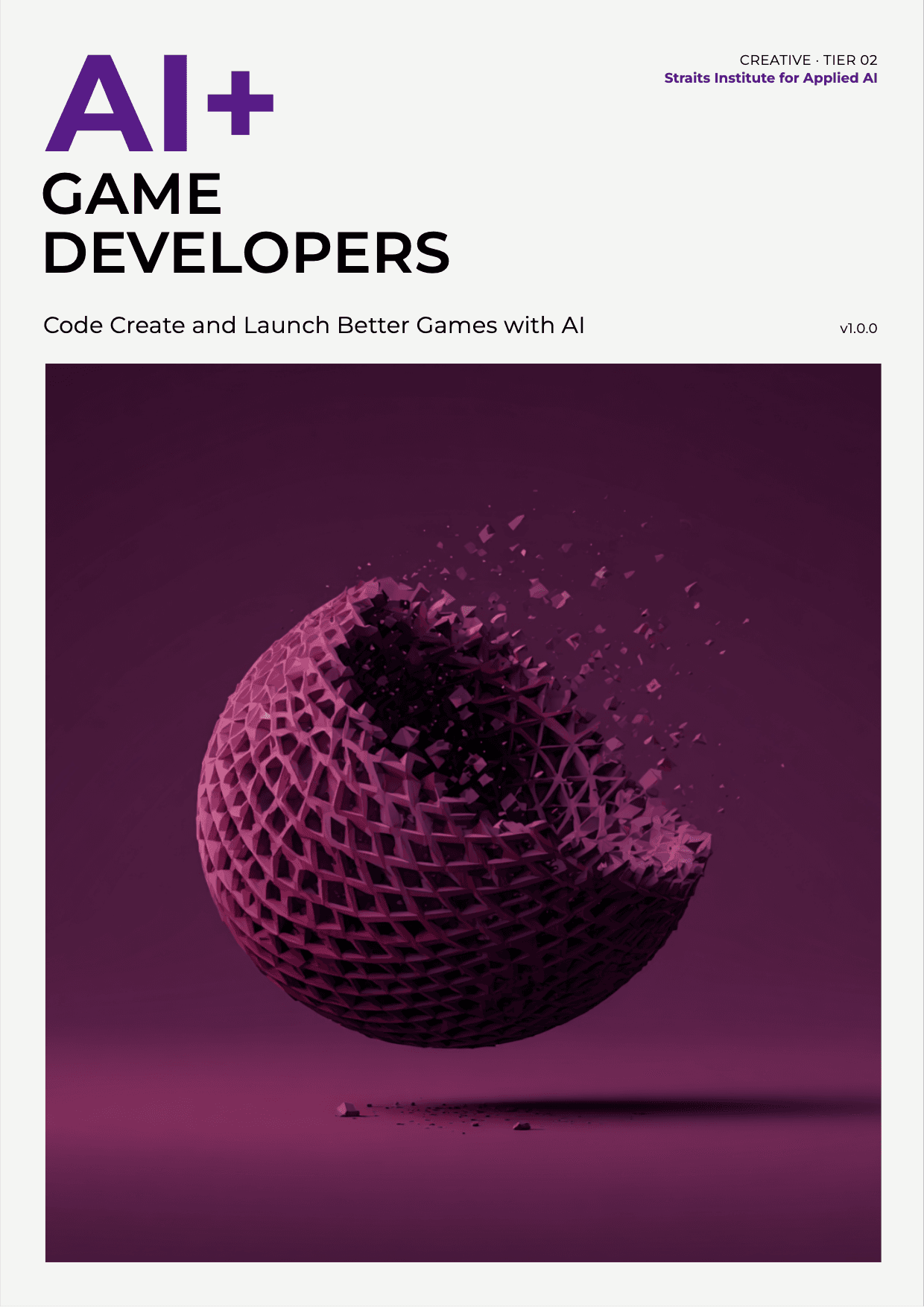
AI+ Game Developers
Code, Create and Launch Better Games with AI
Code is the easy part.
You're building a game — and everything that isn't code is eating the time you need to make it good. Dialogue for 150 NPCs. A Steam page you've rewritten four times. Bug reports that say "thing breaks sometimes." The SPARK Framework gives you a single, memorable practice for using AI across your full pipeline — code, narrative, assets, QA, and publishing — without losing creative control or exposing yourself to IP risk. Includes 35 copy-ready prompts, the 30-Day Game Developer AI Starter Plan, and a practical guide to platform AI disclosure. Built by an AI engineering firm for game developers who have the craft — and need AI to handle everything around it.
- 35 copy-ready prompts: game scripting, NPC dialogue, GDD drafting, QA documentation, and store pages
- The SPARK Framework — 5-step AI workflow: Scope, game context, Adapt, Review, Keep records
- The Game Developer IP Checklist — 5 questions to answer before shipping any AI-assisted asset
- Platform AI disclosure guidance for Steam, App Store, Google Play, and Epic Games Store
- A 30-day plan for solo developers and studio teams, mapped to your engine and pipeline
A game developer at the indie, mid-size studio, or AAA level — experienced in their craft (Unity, Unreal, Godot, or equivalent) but uncertain how to integrate AI tools into a discipline where creativity, code, and IP intersect in complex ways. May be a solo developer wearing every hat (coder, writer, designer, artist, marketer) or a specialist in a studio who handles one layer of the stack.
Also for:A technical game designer who codes: someone who architects gameplay systems, writes game design documents, and implements mechanics — occupying the creative-technical intersection where game dev AI tools are most powerful. Also useful for studio producers and lead developers building AI workflows for their teams.
- Apply the SPARK Framework and Game Developer Prompt Toolkit across the full game development pipeline — code, narrative, assets, QA, and publishing — producing professional-standard outputs materially faster
- Apply the SHIP Protocol (T2-26) and a game-specific IP/attribution checklist to classify game project data before any AI interaction, correctly identifying source code sensitivity, proprietary design documents, licensed assets, and player data
- Evaluate AI-generated code, dialogue, and game assets using structured review criteria before committing to the project build
- Design a 30-Day Game Developer AI Starter Plan identifying at least three high-value AI applications in their specific genre, engine, and workflow
- Navigate AI disclosure obligations on major publishing platforms (Steam, App Store, Google Play, Epic Games Store) with confidence
- Diagnostic
- How AI-ready is your game development practice?
- Chapter 1
- AI in Game Development Right Now
- Chapter 2
- Your Developer AI Toolkit
- Chapter 3
- Prompting AI for Code and Game Systems
- Chapter 4
- Writing the Game — Narrative, Dialogue, and Design Documents
- Chapter 5
- Assets, Audio, and the Production Pipeline
- Chapter 6
- Game AI and Procedural Systems
- Chapter 7
- QA, Bugs, and Technical Documentation
- Chapter 8
- Publishing, Marketing, and Community
- Chapter 9
- Your 30-Day Game Developer AI Starter Plan
- Back matter
- Skill Summary · Recommended Next Reads · Glossary · Tool Reference
Built by an AI engineering firm for game developers who have the craft — and need AI to handle everything around it.
Often read alongside this title.
 T2-102 · Job RolesAI+ Fashion Designers
 T2-140 · Job RolesAI+ Interior Designers
 T3-13 · Job SkillsAI+ Scriptwriting
 T3-14 · Job SkillsAI+ Storytelling
 T2-26 · Job RolesAI+ Software Developers
 T2-27 · Job RolesAI+ IT Managers
 T2-28 · Job RolesAI+ Cybersecurity Professionals
 T2-29 · Job RolesAI+ Data Analysts