
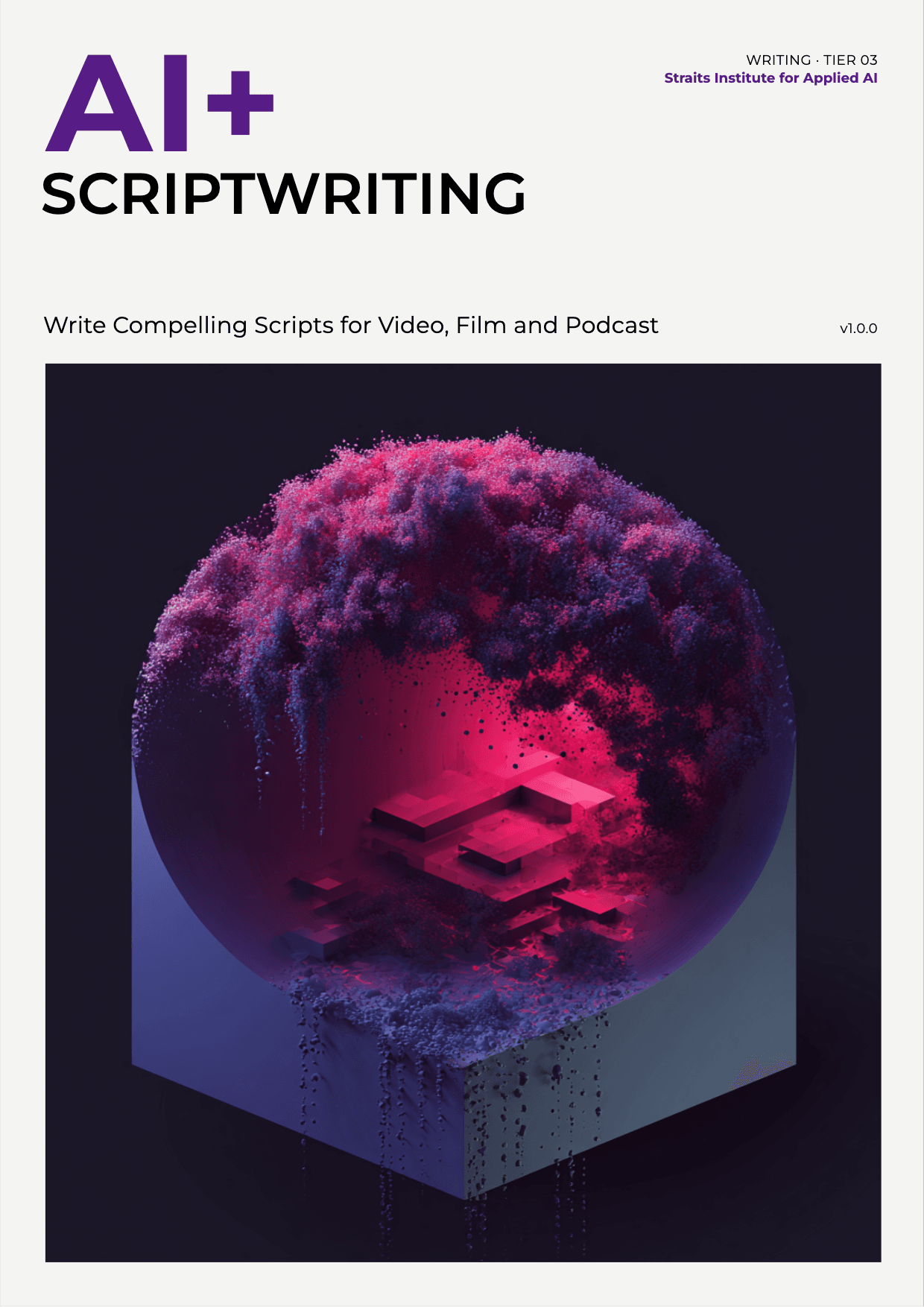
AI+ Scriptwriting
Write Compelling Scripts for Video, Film and Podcast
Idea to working script. Without the AI flatness.
You've asked an AI to write a script and got something technically organised and completely inert — the facts right, the voice wrong, the structure fine for reading and wrong for filming. This book gives scriptwriters the CRAFT workflow to move from brief to locked script systematically, a voice-matching method for writing in any presenter's register, the Scriptwriting Prompt Toolkit (33 prompts across the full lifecycle), and format-specific guidance for corporate video, YouTube, podcast, documentary, and short film. Better scripts, faster.
- 33 ready-made, market-tested prompts: concept development, structure, scene writing, dialogue, format-specific drafts, revision
- The Scriptwriting Prompt Toolkit — format-specific templates for video, film, podcast, training content, and short-form
- A scene construction discipline that uses AI for structure and exploration while preserving the writer's voice and the producer's brief
- The SCREEN Protocol applied to IP, performer rights, and production disclosure
- A 30-day plan for corporate communicators, content creators, podcast producers, documentary makers, and independent filmmakers
Anyone who needs to write compelling scripts as part of their work — not necessarily a professional screenwriter. This includes: corporate communications and L&D professionals scripting training videos, explainers, and internal communications; marketing and content teams producing YouTube videos, social content, and brand stories; podcast producers deciding what to script and what to outline; documentary makers and journalists moving into video; independent filmmakers at the development stage; communications and PR professionals scripting executive interviews and spokesperson briefs; educators creating video learning content; anyone who has been asked to "write a script" and is unsure where to start. The common challenge: a visual or audio idea in their head that needs to become a working document someone else can produce from.
Also for:Aspiring screenwriters building foundational craft before moving into feature or TV; video editors who want to develop scripting skills; directors who script their own work; producers who want to understand what makes a script producible; students in media, communications, or journalism programmes.
- Apply the AI Opportunity Matrix and Augmentation Ladder to map scriptwriting tasks across Automate, Augment, Protect, and Explore — identifying what AI can reliably draft, what it can stress-test, and what requires the writer's undivided creative judgement
- Use the PRISM Prompting Framework and the Scriptwriting Prompt Toolkit to brief AI for concept development, structure, scene writing, dialogue, and script revision across multiple formats
- Write scripts that work for their intended medium — corporate and training video, YouTube and short-form social, podcast, documentary, and dramatic short film — applying format-specific structural conventions and visual/audio storytelling principles
- Revise AI-assisted scripts for voice, timing, and producibility — using TRUST as a script quality evaluation lens
- Apply the SCREEN Protocol (T2-48) and the AI Safety Checklist to navigate IP, performer rights, and production disclosure obligations before submitting or handing off a script
- Diagnostic
- How AI-ready is your scriptwriting practice?
- Chapter 1
- AI in Scriptwriting Right Now
- Chapter 2
- The Scriptwriter's AI Workflow
- Chapter 3
- Script Structure and Story Architecture
- Chapter 4
- Visual Storytelling: Writing What the Camera Sees
- Chapter 5
- Dialogue and Voice: Writing What the Audience Hears
- Chapter 6
- Scripting Across Formats
- Chapter 7
- Development, Revision, and Locked Script
- Chapter 8
- Authorship, Rights, and the Production Pipeline
- Chapter 9
- Scriptwriting Prompt Toolkit and Your 30-Day Plan
- Back matter
- Skill Summary · Recommended Next Reads · Glossary · Tool Reference
Built by an AI engineering firm — for scriptwriters whose words have to work behind the camera, not just on the page.