
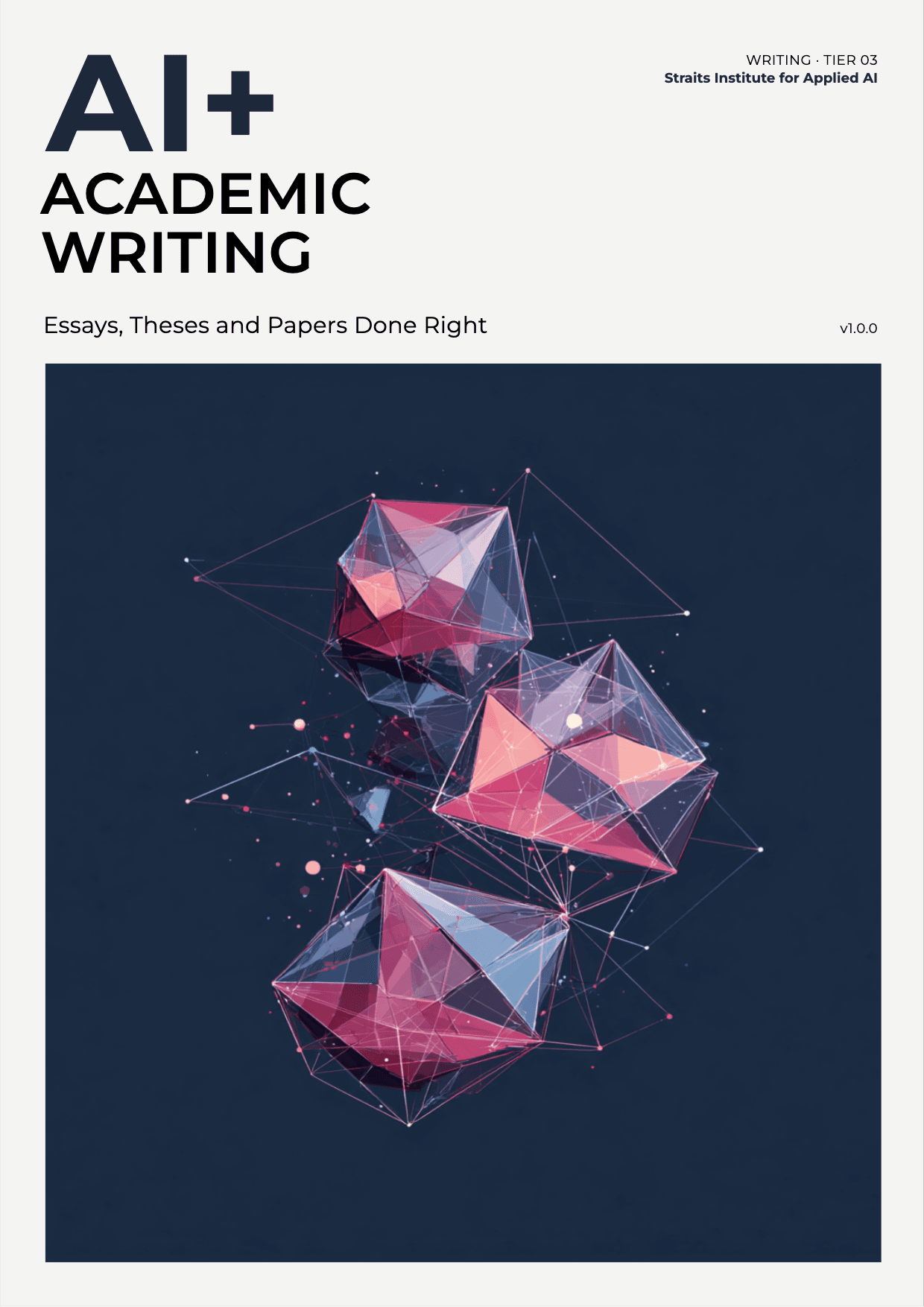
AI+ Academic Writing
Essays, Theses and Papers Done Right
Argument structured. Voice intact. Defensible under viva.
You know your argument — getting it from notes to defensible prose is what takes so long. AI helps with the words but sometimes loses your voice and your point. This book gives academic writers the Academic Writing Prompt Toolkit (33 prompts from planning through submission), a scholarly voice preservation method, and practical guidance on integrity and disclosure. Written by engineers who know the argument belongs to you.
- 33 ready-made, market-tested prompts: argument structuring, draft scaffolding, source integration, editing for clarity, abstract and conclusion drafting, disclosure framing
- An argument architecture workflow that turns notes into a defensible draft in hours, not days
- A source integration discipline that weaves evidence into argument — not bolts citations on
- An AI disclosure approach aligned with current institutional, journal, and supervisor norms
- A 30-day plan for postgraduates, doctoral candidates, academics, journal authors, and dissertation writers
Anyone doing academic or scholarly writing at a serious level: postgraduate students (masters, PhD) writing dissertations and thesis chapters; academic researchers and lecturers producing journal articles, conference papers, and book chapters; advanced undergraduates writing extended dissertations or capstone projects; policy researchers and think-tank analysts writing formal reports or policy briefs; clinicians and health professionals writing case reports, systematic review write-ups, and clinical guidelines. Cross-sector by design — the writing craft is the same regardless of discipline.
Also for:PhD supervisors and academic editors working with AI-assisted student drafts; professionals who write formal, research-grounded outputs in regulated or prestigious contexts (lawyers writing opinions, consultants writing client reports); non-native English speakers at graduate level for whom AI editing support is particularly high-value.
- Plan a structured academic argument using AI as a thought partner before writing a word of prose
- Draft and iterate on academic prose — including notoriously difficult sections such as introductions, abstracts and conclusions — using AI to accelerate without surrendering voice
- Integrate sources and evidence into an argument with appropriate citation, distinction between paraphrase and quotation, and defensible prose ownership
- Edit academic writing for clarity, precision, academic register and structural coherence using AI-assisted review
- Adapt writing for different academic genres — essays, thesis chapters, journal articles, research proposals, conference abstracts — with genre-specific AI prompting
- Disclose AI assistance in line with current institutional, journal, and professional norms while maintaining a defensible audit trail
- Diagnostic
- How AI-ready is your academic writing?
- Chapter 1
- AI in Academic Writing Right Now
- Chapter 2
- The Academic Writing Workflow with AI
- Chapter 3
- Planning and Structuring Your Argument
- Chapter 4
- First Drafts: From Notes to Prose
- Chapter 5
- Integrating Sources and Evidence
- Chapter 6
- Editing for Clarity and Academic Register
- Chapter 7
- Voice, Originality, and the Over-Reliance Risk
- Chapter 8
- Writing Across Genres
- Chapter 9
- Academic Integrity and Disclosure
- Chapter 10
- Your 30-Day Academic Writing Plan
- Back matter
- Skill Summary · Recommended Next Reads · Glossary · Tool Reference
Built by an AI engineering firm — for academic writers whose argument is theirs, and whose defence has to hold.
Often read alongside this title.
 T3-01 · Job SkillsAI+ Academic Research
 T1-03 · EssentialsAI+ Students
 T3-84 · Job SkillsAI+ Quantitative Research & Statistics
 T3-65 · Job SkillsAI+ Critical Evaluation
 T3-11 · Job SkillsAI+ Technical Writing
 T3-83 · Job SkillsAI+ Systematic Literature Reviews
 T3-85 · Job SkillsAI+ Laboratory Research & Experimental Design
 T3-29 · Job SkillsAI+ Data Analysis