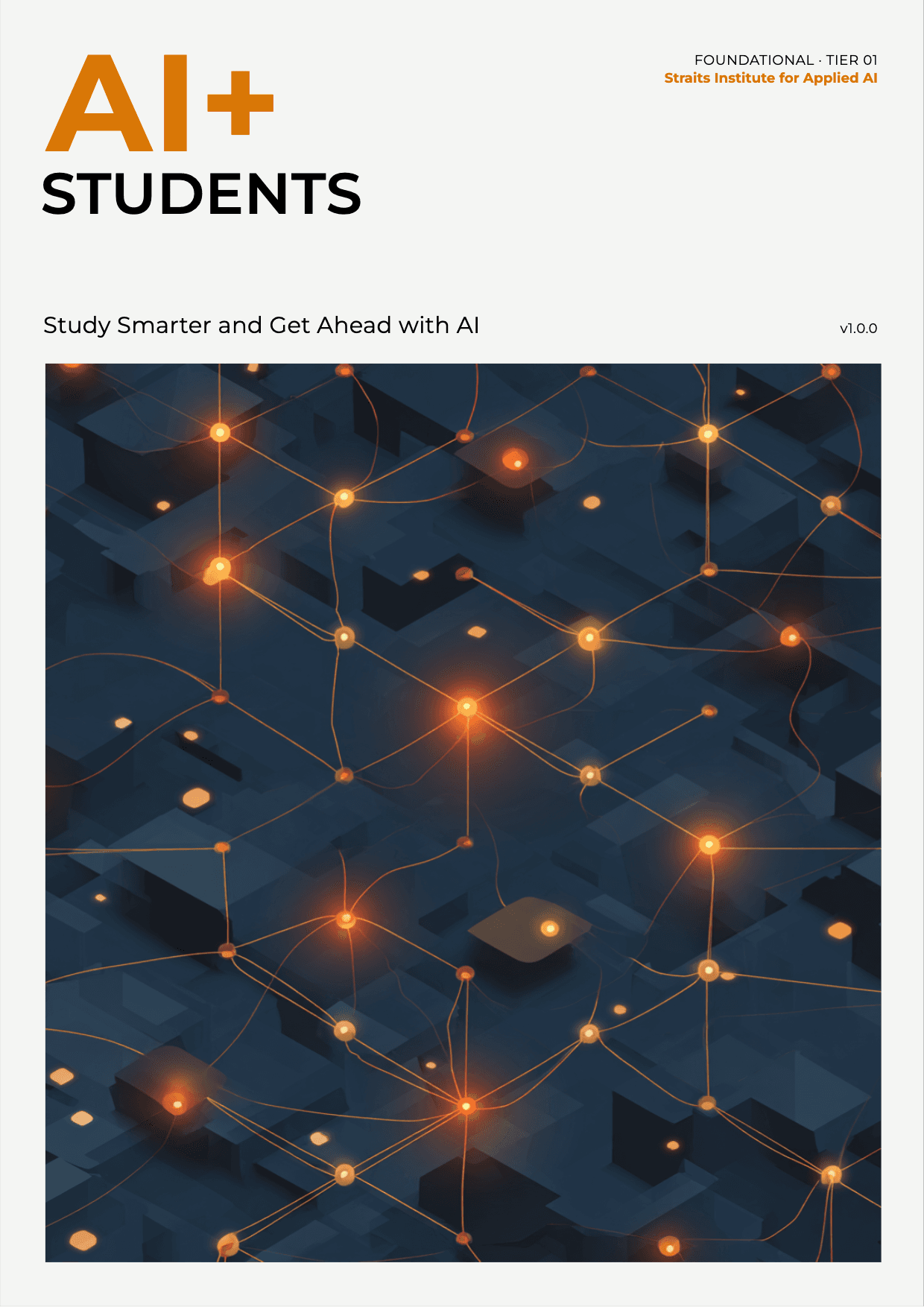
AI+ Students
Study Smarter and Get Ahead with AI
Use AI to learn more, not less.
Every student has heard "be careful with AI" — but almost none have been told what that actually means in practice. This book gives you clear rules for research, writing, revision, and submission. You'll know what's permitted, what's problematic, and how to use AI as a genuine study partner. Written for students by an AI engineering firm that thinks integrity and AI literacy aren't opposites.
- 30 ready-made, market-tested prompts: research, essay drafts, revision, group work, presentations
- The Learning-or-Outsourcing test for any AI-assisted task you're not sure about
- A citation verification protocol that catches AI hallucinations before they hit your reference list
- The TRUST framework applied to academic research and AI-suggested sources
- A 30-day plan built around the actual rhythm of term — reading week, deadlines, exams
Undergraduate students (years 1–4) at universities, colleges, polytechnics, and equivalent institutions globally. Any discipline — STEM, humanities, social sciences, business, creative arts, vocational/applied. They are learning the skills and knowledge of their field for the first time. They take exams, write essays, do group work, present, and (for many) work part-time alongside studies. They are digital natives but that does not mean they are AI-fluent.
Also for:Sixth-form / A-level / final-year secondary students preparing for university or professional training; postgraduate taught students (taught masters) for whom this is still useful even though STU-02 extends further; mature students returning to study after time in work; international students navigating AI policy variation across institutions and countries.
- Apply the PRISM Prompting Framework to core study tasks (explaining concepts, working through problems, drafting essays, revising for exams)
- Evaluate AI output for accuracy, relevance, and academic suitability using the TRUST Framework
- Use AI safely within their institution's academic integrity policy — knowing when to declare, when to disallow, and when to verify
- Protect their own work, data, and digital footprint using the AI Safety Checklist
- Build a personal 30-day study plan that integrates AI into research, writing, revision, and presentations
- Diagnostic
- How AI-Ready a Student Are You?
- Chapter 1
- AI on Campus Right Now
- Chapter 2
- AI Basics for Students
- Chapter 3
- How to Prompt AI (for Learning, Not Just Answers)
- Chapter 4
- AI for Research
- Chapter 5
- AI for Writing
- Chapter 6
- AI for Studying and Exams
- Chapter 7
- AI for Presentations and Group Work
- Chapter 8
- Academic Integrity — Using AI the Right Way
- Chapter 9
- AI, Data and Your Digital Footprint
- Chapter 10
- AI for Your Career and Your 30-Day Student AI Plan
- Back matter
- Skill Summary · Recommended Next Reads · Glossary · Tool Reference
Built by an AI engineering firm — for students who think integrity and AI literacy aren't opposites.
Often read alongside this title.
 T3-01 · Job SkillsAI+ Academic Research
 T3-09 · Job SkillsAI+ Academic Writing
 T1-03W · WorkbookAI+ Student Workbook
 T3-84 · Job SkillsAI+ Quantitative Research & Statistics
 T1-13 · EssentialsAI+ School Students
 T3-23 · Job SkillsAI+ Presentations
 T3-65 · Job SkillsAI+ Critical Evaluation
 T4-10 · SpecialAI+ Future Skills