
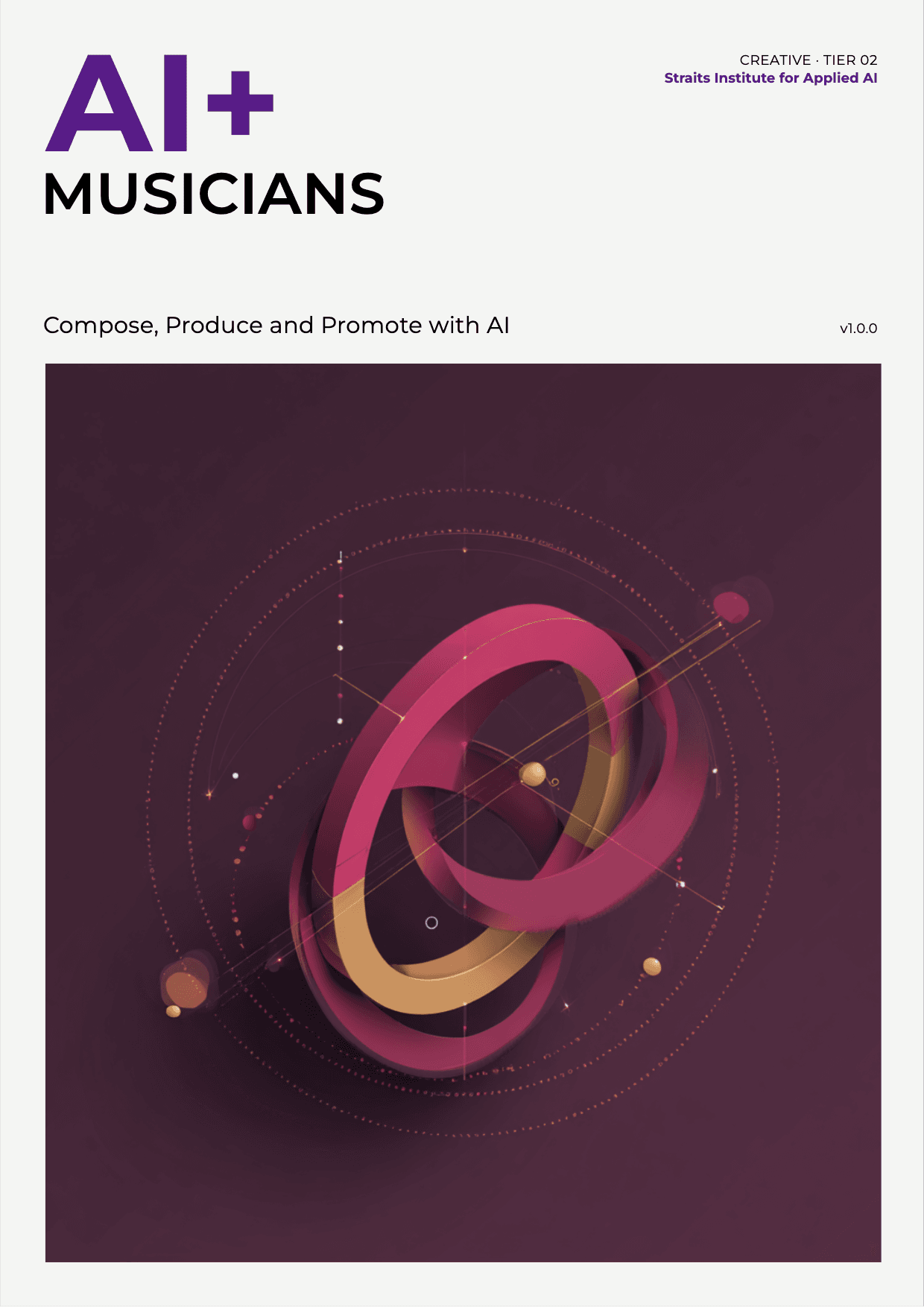
AI+ Musicians
Compose, Produce and Promote with AI
Use AI in your business. Keep AI out of your voice.
You're spending half your working week on emails, pitches, and promotion — and still behind on all of it. Meanwhile, AI is reshaping the music industry in ways that feel threatening before they feel useful. This book gives you both sides: the SOUND Protocol to protect your recordings and navigate copyright honestly, the Music Business Prompt Toolkit with 28+ copy-ready templates for every document a music career requires, and a practical framework for using AI in composition and production without losing what makes your music yours. Built by practitioners. Your voice stays yours.
- 50+ ready-made, market-tested prompts: sync pitches, grant applications, press releases, EPK content, fan newsletters, songwriting and production briefs
- The SOUND Protocol — five-check framework for stems and unreleased audio, ownership documentation, usage rights, voice and identity, and disclosure
- The Music Business Prompt Toolkit — 28 templates for the administrative work that consumes your creative time
- AI production discipline for mixing, mastering, sound design, and stem separation — with quality calibration included
- A 30-day plan for indie artists, producers and beatmakers, film and TV composers, and session musicians
A working musician whose income depends partly or wholly on music — whether composing, performing, producing, or some combination. This includes: independent singer-songwriters releasing music on streaming platforms; music producers and beatmakers supplying tracks to other artists or sync libraries; film, TV, and media composers scoring visual content; session musicians and multi-instrumentalists; touring artists and bands managing their own promotion; and music teachers and coaches with active performance or recording practices. They typically work across multiple revenue streams simultaneously — live performance, streaming royalties, sync licensing, session work, teaching, and direct fan sales — because no single stream pays enough alone. Their relationship with technology is pragmatic: they adopted home recording and digital audio workstations (DAWs) because it gave them genuine creative and financial independence. They will adopt AI for the same reason — if it genuinely helps.
Also for:Music industry adjacent professionals who work closely with artists: artist managers, independent label operators, music publishers, sync agents, booking agents, and label A&R staff who want to understand how AI is reshaping the creative process and the musician's toolkit. Also: music technology students and conservatoire graduates entering an industry already transformed by AI.
- Use AI as a creative composition and songwriting partner — applying it to generate harmonic options, lyric drafts, structural ideas, and reference arrangements while maintaining the artistic voice and creative decision-making that defines the musician's work
- Apply AI tools across the music production workflow — from sound design and arrangement to mixing and mastering assistance — identifying where AI genuinely accelerates professional output and where human production judgement is non-negotiable
- Use AI to manage the music business tasks that consume creative time — including sync licensing pitches, grant applications, press releases, EPK content, and audience communications — producing professional-quality business documents without professional writing staff
- Apply the SOUND Protocol to AI use in music contexts — protecting unreleased recordings, understanding ownership implications of AI-assisted composition, and making principled decisions about what to share with AI tools and what to keep off-platform
- Navigate the copyright, training data, and ethical questions that are specific to AI in music — taking positions grounded in understanding of the current landscape rather than anxiety or uncritical acceptance
- Diagnostic
- How AI-Ready Is Your Music Practice?
- Chapter 1
- AI in Music Right Now
- Chapter 2
- What AI Can (and Cannot) Do for Musicians
- Chapter 3
- AI for Composition and Songwriting
- Chapter 4
- AI for Production and Sound Design
- Chapter 5
- AI for the Music Business
- Chapter 6
- AI for Promotion, Marketing, and Audience Building
- Chapter 7
- Copyright, Training Data, and Your Rights
- Chapter 8
- Your 30-Day Musician AI Starter Plan
- Back matter
- Skill Summary · Recommended Next Reads · Glossary · Tool Reference
Built by an AI engineering firm — for musicians who want their administrative hours back, with their voice intact.