
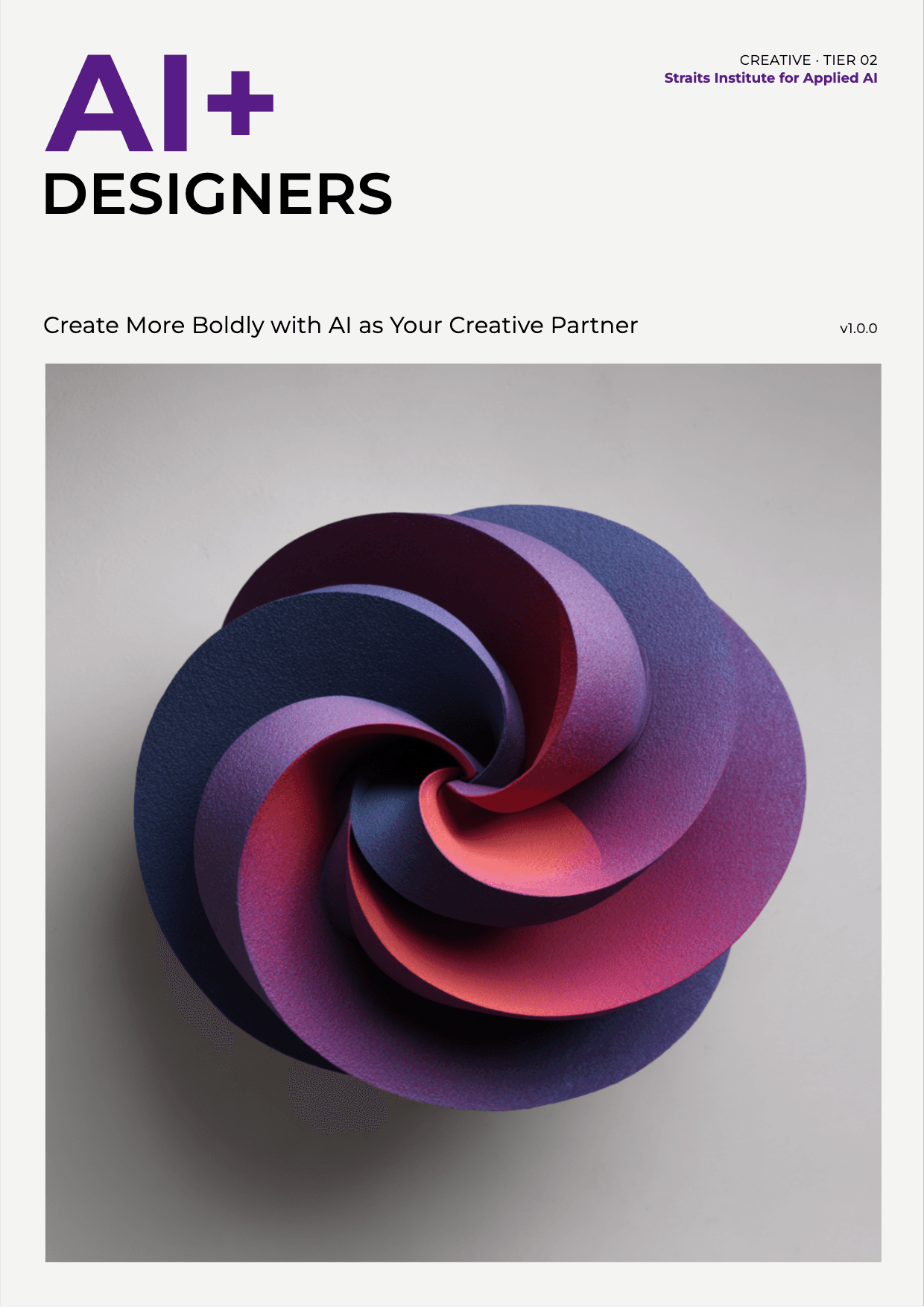
AI+ Designers
Create More Boldly with AI as Your Creative Partner
More concept directions. Same creative judgement.
You're generating more visual output than ever and spending more time adapting assets than designing them. Meanwhile, AI image tools keep improving and clients keep asking whether you're using them. This book gives designers the BRIEF Framework for integrating AI across the full design workflow — from concepting to delivery — plus 30+ copy-ready prompts, the VISUAL Protocol for professional image generation, and a structured approach to UX research synthesis. Built by an AI engineering firm. Your creative judgement stays yours.
- 30+ ready-made, market-tested prompts: brief decoding, mood boards, concept exploration, image generation direction, UX research synthesis, client communication
- The BRIEF Framework — Brief, Reference, Ideate, Execute, Finish — the five-stage AI-augmented design production workflow
- The VISUAL Protocol — six-check framework for image provenance, client asset protection, representation, use-case rights, accessibility, and licensing documentation
- A multi-direction concepting discipline that doubles the number of concepts you can develop for a pitch
- A 30-day plan for graphic designers, UX/product designers, freelancers, and in-house design teams
A visual design professional with 2–10 years of experience whose primary work is creating designed artefacts — brand identities, graphic assets, digital interfaces, print materials, packaging, illustrations, or environmental design. This includes: graphic designers, brand designers, visual designers, UI designers, UX/product designers, art directors, motion designers, and freelance designers working across multiple disciplines. They may work at a design agency producing brand identity and campaigns for clients, in-house at a company designing for one brand across channels, at a tech company designing digital products, or independently as a freelance designer. Their daily work spans the full design cycle: decoding client briefs, gathering references and inspiration, developing concepts, designing and producing assets, iterating based on feedback, and delivering final files. They are acutely aware that AI can generate images — and deeply uncertain about what that means for their professional value, their tools, and the ownership of what they create.
Also for:Art directors who lead design teams but still produce work themselves; product managers who work closely with design and want to understand AI's design implications; marketing managers responsible for visual output; creative directors who want to understand designer-level AI adoption before their T2-85 read; illustrators and motion designers extending into broader design contexts.
- Apply the BRIEF Framework to integrate AI across the full design production workflow — from brief decoding and reference gathering through multi-direction concepting, design execution, and final delivery — without substituting AI for the design judgement that makes work distinctive
- Use the PRISM Prompting Framework and Designer's Prompt Toolkit (30+ prompts) to brief AI for design-specific tasks including concept development, image generation direction, UX research synthesis, client communication, and design critique
- Evaluate and select AI-generated visual outputs using professional design criteria — quality, brand alignment, representation, accessibility, and originality — applying the TRUST Framework and designer's editorial judgement before any AI-generated element enters a client deliverable
- Apply the VISUAL Protocol before any AI interaction involving client brand assets, image generation for commercial use, or AI-assisted design decisions — covering provenance, client asset protection, representation screening, use-case compliance, accessibility review, and licensing documentation
- Design a UX research workflow using AI for synthesis, pattern identification, persona development, and journey mapping — while protecting participant privacy and maintaining the human interpretation that makes research actionable
- Diagnostic
- How AI-Ready Is Your Design Practice?
- Chapter 1
- AI in Design Right Now
- Chapter 2
- What AI Can and Cannot Do for Designers
- Chapter 3
- How to Prompt AI for Design Work
- Chapter 4
- AI for Research and Inspiration
- Chapter 5
- AI for Concepting and Creative Direction
- Chapter 6
- AI for Design Production
- Chapter 7
- AI for UX Research and User-Centred Design
- Chapter 8
- Protecting Brand Identity and Design Quality
- Chapter 9
- Design Safety, Copyright and Ethics
- Chapter 10
- Your 30-Day Designer AI Starter
- Back matter
- Skill Summary · Recommended Next Reads · Glossary · Tool Reference
Built by an AI engineering firm — for designers who direct AI as deliberately as they direct everything else.