
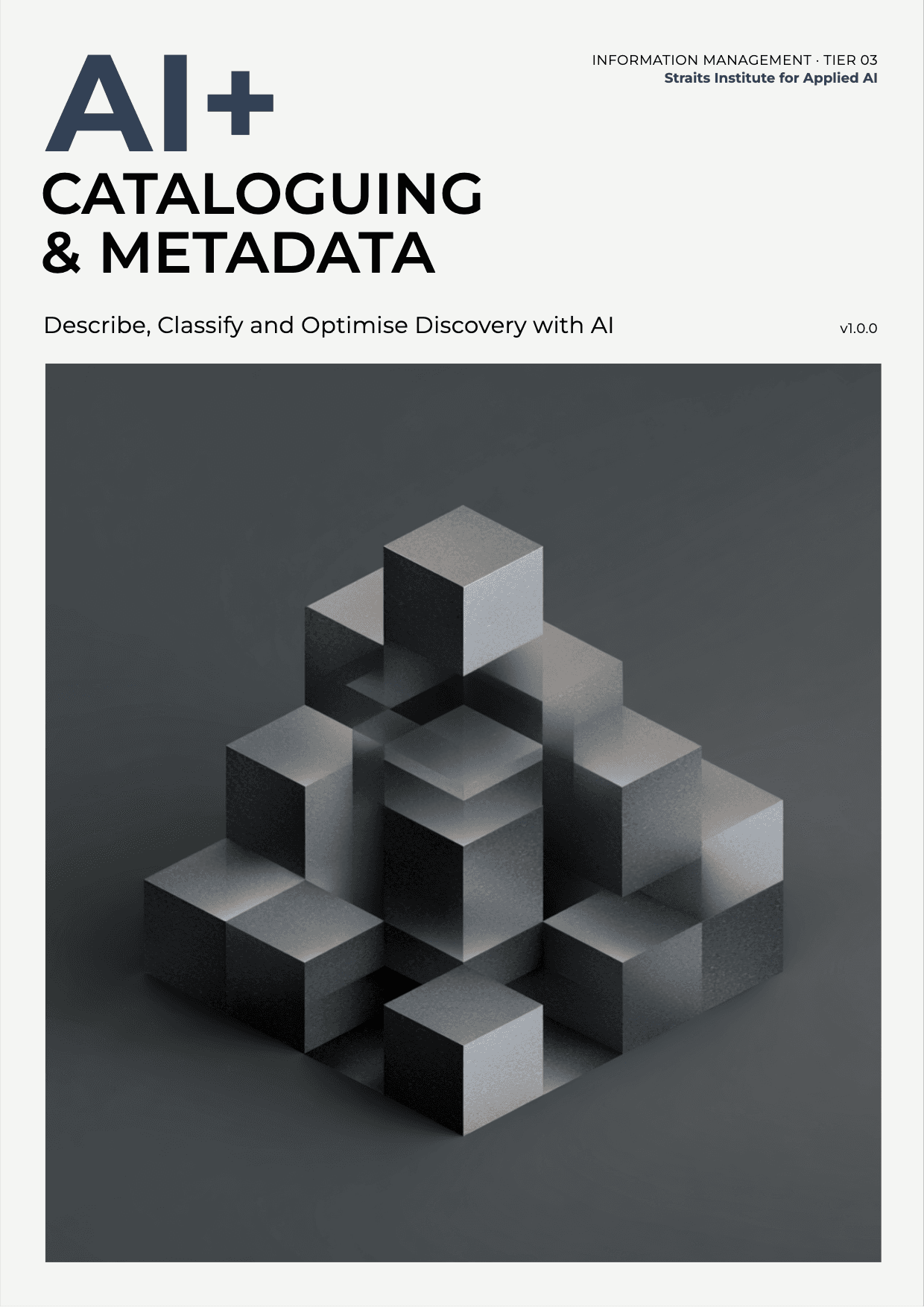
AI+ Cataloguing & Metadata
Describe, Classify and Optimise Discovery with AI
The backlog is real. The expertise is yours. The system is missing.
Your backlog keeps growing and the time to clear it keeps shrinking. AI doesn't replace your cataloguing expertise — it handles the routine extraction and drafting so your judgement goes where it matters: classification decisions, authority control, quality assurance. The ENRICH Protocol gives you a six-step AI workflow for MARC21, Dublin Core, RDA, and schema.org, with 40+ copy-ready prompts and a 90-day adoption plan. Built by an AI engineering firm for cataloguers who know the standards — and need a faster, more sustainable way to apply them.
- 40+ copy-ready prompts for record creation, subject analysis, authority control, batch processing, and discovery optimisation
- The ENRICH Protocol — a six-step cataloguing workflow that maps exactly where AI helps and where professional judgement leads
- The Five-Point Metadata QA Framework — a structured checklist for AI-generated records that catches systematic errors before they reach the catalogue
- Four batch workflow archetypes for clearing backlogs of minimal-level, pre-RDA, and subject-sparse records at scale
- A 90-day adoption plan with a workflow redesign template and a business case template for management
Library cataloguers and technical services staff (paraprofessional and professional), metadata librarians and specialists, and digital projects librarians working in academic, public, national, or special library settings.
Also for:Archivists and records managers managing finding aids and archival description; digital asset managers in publishing, media, and enterprise; LIS students and early-career information professionals; repository managers working with DSpace, ArchivesSpace, or Omeka.
- Apply AI tools to create and enhance bibliographic records in MARC21, Dublin Core, RDA, and schema.org formats
- Use AI to assign classification numbers (Dewey, LC) and subject headings (LCSH, MeSH) with professional-level accuracy and compliance
- Implement authority control and linked-data enrichment using AI to connect records to VIAF, LCNAF, and Wikidata
- Design batch-processing workflows to enhance legacy metadata records at scale without sacrificing quality standards
- Evaluate AI-generated metadata for completeness, accuracy, and standards compliance using structured quality-assurance criteria
- Diagnostic
- How AI-ready is your cataloguing practice?
- Chapter 1
- AI in Cataloguing & Metadata Right Now
- Chapter 2
- Metadata Fundamentals in the AI Era
- Chapter 3
- AI-Assisted Descriptive Cataloguing
- Chapter 4
- Classification and Subject Analysis with AI
- Chapter 5
- Authority Control and Linked Data with AI
- Chapter 6
- Metadata Quality Assurance with AI
- Chapter 7
- Legacy Record Enhancement and Retrospective Conversion
- Chapter 8
- Digital Collections, Repositories, and Archives
- Chapter 9
- Metadata for Discovery: Interoperability and the Web
- Chapter 10
- Building an AI-Enhanced Cataloguing Practice
- Back matter
- Skill Summary · Recommended Next Reads · Glossary · Tool Reference
Built by an AI engineering firm for cataloguers who know the standards — and need a faster, more sustainable way to apply them at scale.
Often read alongside this title.
 T3-15 · Job SkillsAI+ Report Writing
 T3-89 · Job SkillsAI+ Records & Information Management
 T3-95 · Job SkillsAI+ Monitoring & Evaluation
 T3-01 · Job SkillsAI+ Academic Research
 T2-41 · Job RolesAI+ Civil Servants
 T2-70 · Job RolesAI+ Public Service Leaders
 T2-43 · Job RolesAI+ Policy Makers
 T2-44 · Job RolesAI+ Public Health Workers