
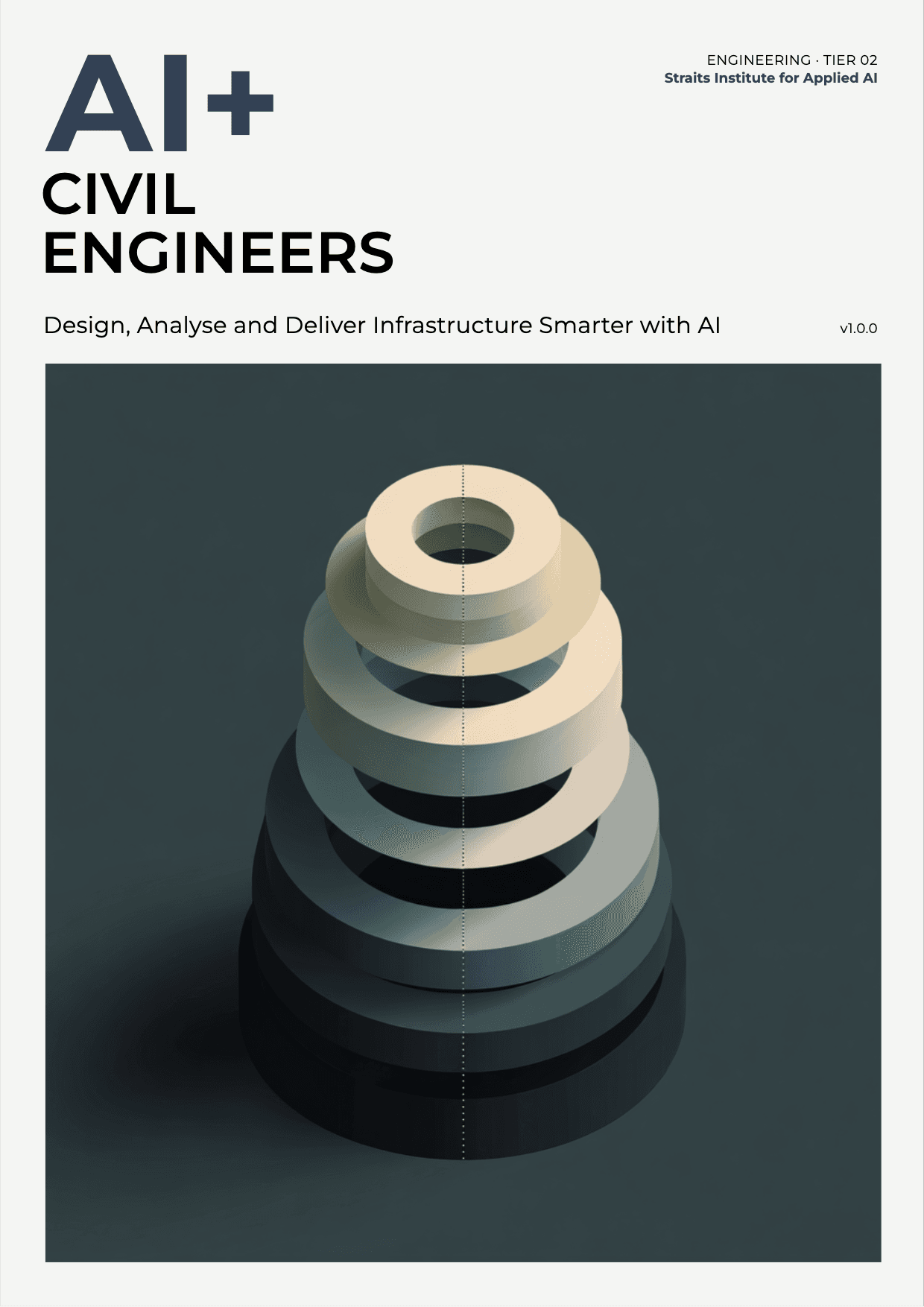
AI+ Civil Engineers
Design, Analyse and Deliver Infrastructure Smarter with AI
Your judgement was never the bottleneck. The paperwork around it was.
The specification is finished, the calculations are checked twice, and Friday's client meeting still needs a design comparison memo, three technical query responses, and a report narrative you haven't started. This book gives you the SIGN Protocol for safe AI use around structural and geotechnical data, the Governing Standards Check that catches a superseded code clause before it costs you, and the Engineer's Prompt Toolkit's civil-engineering prompts for the specifications, reports, and site documentation that eat your week. Built by an AI engineering firm for civil engineers whose judgement is the whole point — so the paperwork stops competing with it.
- 16 ready-made prompts: specifications, calculation narratives, technical queries, standards checks, site reports.
- The SIGN Protocol — four checks before any AI touches structural or geotechnical project data.
- The Governing Standards Check — catch a superseded code clause before it costs you.
- The Engineer's Prompt Toolkit — applied to structural, geotechnical, transportation and water resources practice.
- A 30-day plan — for engineers on the PE, CEng or CPEng pathway.
Civil engineers across structural, geotechnical, transportation, and water resources sub-disciplines, working in consultancies, contractors, and public infrastructure agencies. Ranges from early-career graduate engineers through mid-career project engineers to senior/chartered practitioners on the PE (US), CEng (UK/Commonwealth), or CPEng (Australia/NZ) track. Uses CAD/BIM platforms (Revit, Civil 3D, Bentley OpenRoads) and structural/geotechnical analysis software (ETABS, SAP2000, PLAXIS, Slope/W) daily. Works to national and international design codes (Eurocodes, ASCE 7, AASHTO, ACI, local building codes).
Also for:Engineering managers and technical directors in civil/structural consultancies looking to understand how their teams can adopt AI safely; construction professionals and project managers who interface with civil engineering deliverables; university civil engineering faculty and final-year students preparing for practice.
- Apply the SIGN Protocol to classify structural, geotechnical, and project data before any AI interaction
- Use AI as a thought partner across structural analysis, geotechnical interpretation, and transportation/water resources design workflows, with independent numerical verification at every step
- Produce AI-assisted drawing narratives, specifications, and design reports that meet code-compliance and professional sign-off standards
- Evaluate BIM-integrated AI tools, generative design platforms, and construction-monitoring AI for applicability to a specific civil engineering project
- Design a 30-day personal AI integration plan mapped to their sub-discipline (structural, geotechnical, transportation, or water resources) and registration pathway (PE/CEng/CPEng-track)
- Diagnostic
- How AI-Ready Is Your Civil Engineering Practice?
- Chapter 1
- AI in Civil Engineering Right Now
- Chapter 2
- How AI Changes Civil Engineering Work
- Chapter 3
- AI Safety, Data and the SIGN Protocol
- Chapter 4
- AI for Design and Structural Analysis
- Chapter 5
- AI for Geotechnical and Site Investigation Work
- Chapter 6
- AI for Drawings, Specifications and Documentation
- Chapter 7
- AI for Standards, Code Compliance and Project Delivery
- Chapter 8
- AI for Site Supervision and Construction Monitoring
- Chapter 9
- AI for Sustainability, Resilience and Professional Development
- Chapter 10
- Your 30-Day AI Starter Plan for Civil Engineering
- Back matter
- Skill Summary · Recommended Next Reads · Glossary · Tool Reference
Built by an AI engineering firm for civil engineers whose judgement is the whole point — so the paperwork stops competing with it.
Often read alongside this title.
 T2-76 · Job RolesAI+ Engineering Leaders
 T2-31 · Job RolesAI+ Engineers
 T2-143 · Job RolesAI+ Mechanical Engineers
 T2-144 · Job RolesAI+ Electrical & Electronic Engineers
 T2-145 · Job RolesAI+ Chemical & Process Engineers
 T2-146 · Job RolesAI+ Aerospace Engineers
 T2-147 · Job RolesAI+ Biomedical Engineers
 T2-148 · Job RolesAI+ Materials Engineers