
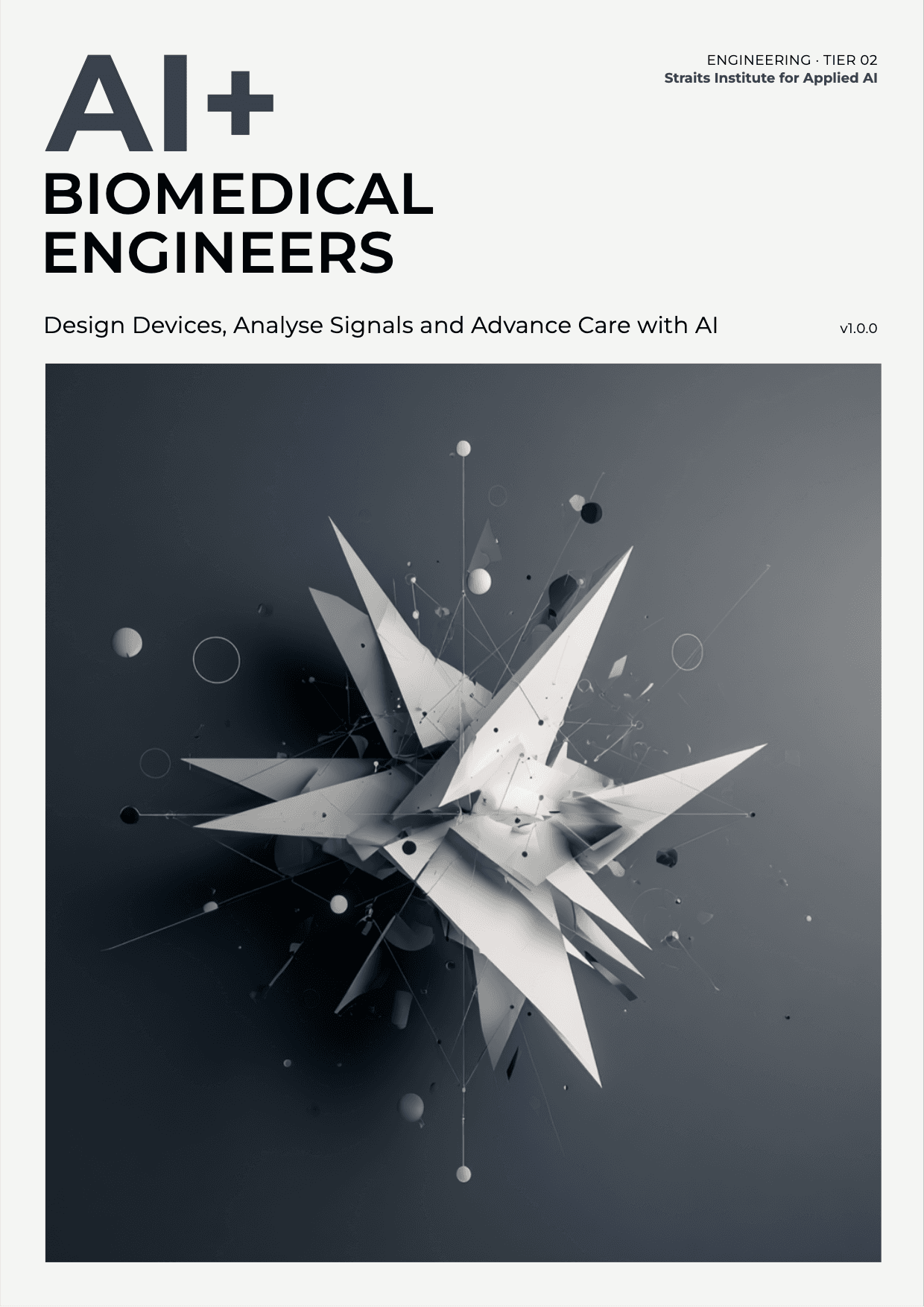
AI+ Biomedical Engineers
Design Devices, Analyse Signals and Advance Care with AI
AI for the risk file, the regulatory section, and the standard you have to get right.
You've caught AI being confidently wrong about a standard once already — enough to make you careful near a design history file. This book gives you the SIGN Protocol for classifying patient and project data, a biomedical-specific prompt toolkit for risk files, V&V protocols and regulatory sections, and a 30-day plan matched to your device category. Built by an AI engineering firm for biomedical engineers who carry real patient-safety accountability — and deserve tools built for that standard.
- 8 ready-made, market-tested prompts: design input specifications, risk narratives, V&V protocols, regulatory submission sections
- The SIGN Protocol — four-check framework for Sensitivity classification, Independent verification, Governing standards check, Non-delegation of professional liability
- A risk management workflow that keeps every severity and probability score with the engineer, never the AI
- A regulatory documentation discipline for design history files, technical file sections, and literature synthesis
- A 30-day plan matched to your device category — diagnostic, implantable, digital health, or hospital/clinical engineering
Biomedical and medical device engineers working in medical device manufacturers, hospital clinical engineering departments, contract design and manufacturing organisations, university medtech research groups, and digital health companies. Typical career stage: 2–15 years post-graduation; holds a BEng/MEng/MSc in biomedical, bioengineering, or a related engineering discipline. Typical titles: Biomedical Engineer, R&D Engineer, Design Engineer, Clinical Engineer, Verification & Validation Engineer, Regulatory Affairs Engineer. Daily work includes: designing and prototyping devices (diagnostic, therapeutic, implantable, wearable, digital health), writing and maintaining design history file (DHF) documentation, performing risk management analysis (ISO 14971), running and interpreting verification and validation (V&V) testing, analysing biosignals (ECG, EEG, EMG, physiological sensor data), drafting regulatory submission content (FDA 510(k)/PMA, EU MDR technical documentation), and collaborating with clinicians, regulatory affairs, and quality teams. Has used conversational AI for drafting emails or summarising papers; has not built a systematic, compliant AI workflow.
Also for:Clinical engineers supporting medical equipment in hospital settings. Graduate biomedical engineers in their first two years. Regulatory affairs specialists working alongside biomedical engineering teams. Academic researchers moving into medtech industry roles.
- Apply the Engineer's Prompt Toolkit (biomedical variant) to at least six recurring tasks — design history file narrative, risk management documentation (ISO 14971), verification and validation protocol drafting, biosignal analysis interpretation, regulatory submission narrative, and clinical/technical literature synthesis
- Apply the SIGN Protocol to classify biomedical project data before any AI interaction — correctly distinguishing patient/clinical data, safety-critical device design data, sponsor-confidential trial data, and general biomedical engineering knowledge
- Evaluate AI outputs against the TRUST Framework with biomedical-specific checks: is the biocompatibility, regulatory, or clinical claim traceable to a real standard or dataset; is any numerical or statistical output independently verified
- Use AI to support device design exploration, signal-processing interpretation, human factors documentation, and regulatory writing — while keeping every design control record, verification result, and clinical claim under independent engineering and regulatory review
- Design a personalised 30-Day Biomedical Engineer's AI Starter Plan matched to their device category (diagnostic, therapeutic, implantable, digital health) and regulatory pathway
- Diagnostic
- How AI-ready is your biomedical engineering practice?
- Chapter 1
- AI in Biomedical Engineering Right Now
- Chapter 2
- The Biomedical Engineer's AI Opportunity
- Chapter 3
- Prompting AI for Biomedical Engineering Work
- Chapter 4
- AI for Device Design and Signal Analysis
- Chapter 5
- AI for Risk Management, Verification and Validation
- Chapter 6
- AI for Regulatory Documentation and Communication
- Chapter 7
- The SIGN Protocol: AI Safety for Biomedical Engineers
- Chapter 8
- Biomedical Engineering with AI Agents and Advanced Tools
- Chapter 9
- Your Career as a Biomedical Engineer in the AI Era
- Chapter 10
- Your 30-Day Biomedical Engineer's AI Starter Plan
- Back matter
- Skill Summary · Recommended Next Reads · Glossary · Tool Reference
Built by an AI engineering firm for biomedical engineers who carry real patient-safety accountability — and deserve tools built for that standard.
Often read alongside this title.
 T2-76 · Job RolesAI+ Engineering Leaders
 T2-31 · Job RolesAI+ Engineers
 T2-142 · Job RolesAI+ Civil Engineers
 T2-143 · Job RolesAI+ Mechanical Engineers
 T2-144 · Job RolesAI+ Electrical & Electronic Engineers
 T2-145 · Job RolesAI+ Chemical & Process Engineers
 T2-146 · Job RolesAI+ Aerospace Engineers
 T2-148 · Job RolesAI+ Materials Engineers