
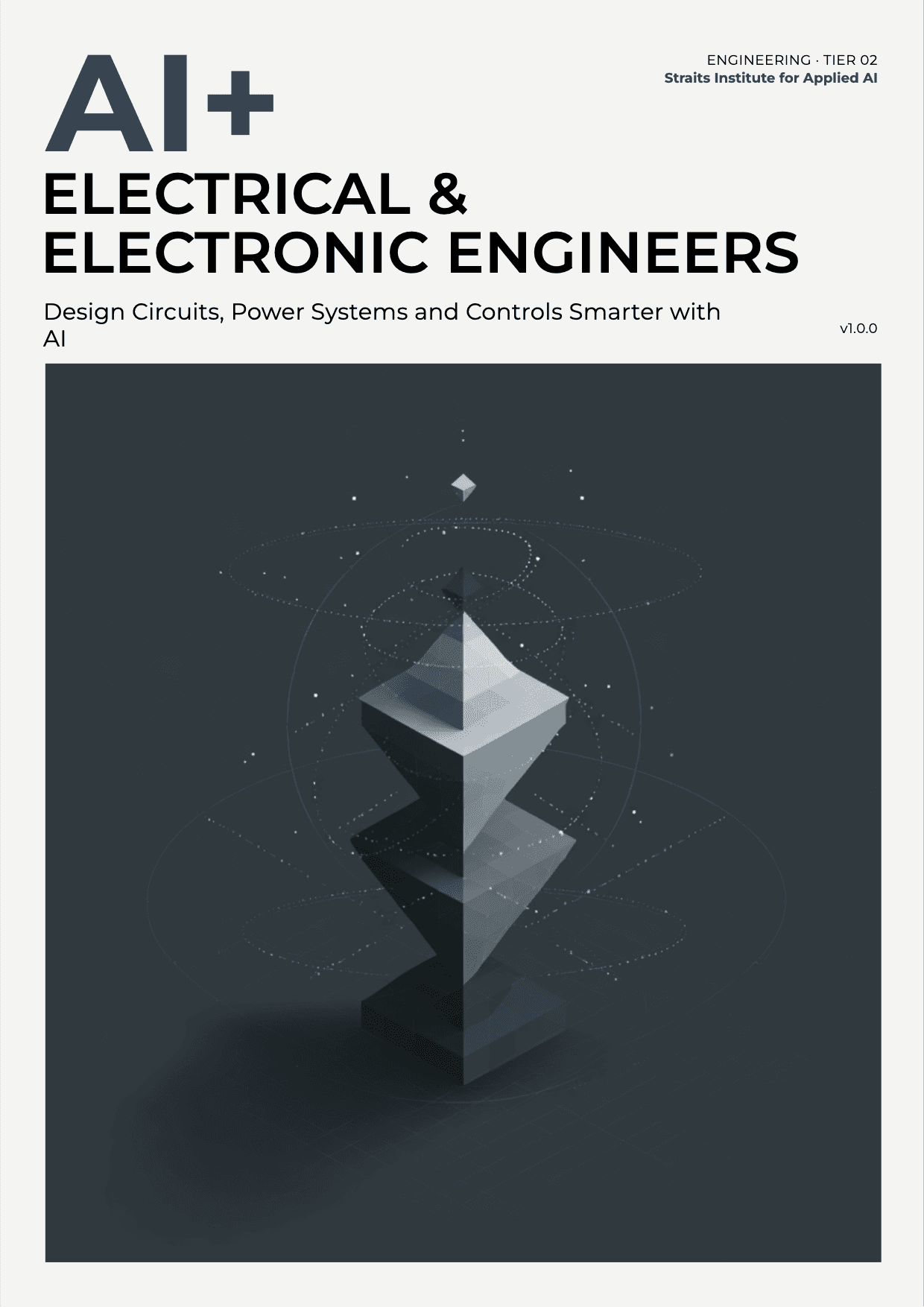
AI+ Electrical & Electronic Engineers
Design Circuits, Power Systems and Controls Smarter with AI
Your judgement was never the bottleneck. The paperwork around it was.
You still check every load-flow result and protection setting by hand — but the design-justification memo and the compliance narrative eat the hours you'd rather spend engineering. This book gives you the SIGN Protocol, the Engineer's Prompt Toolkit, and a 30-day plan for putting AI on the documentation, never the judgement. Built by an AI engineering firm for electrical and electronic engineers who trust their own calculations — and want AI to clear the paperwork out of the way.
- 17 ready-made prompts: circuit comparisons, protection-study summaries, control-tuning reports, standards checks, test plans.
- The SIGN Protocol — four checks before any AI touches circuit, power-system or client project data.
- The Governing Standards Check — catch a superseded IEC or IEEE standard before it costs you.
- The Engineer's Prompt Toolkit — applied to power systems, electronics, control systems and signal processing.
- A 30-day plan — for engineers on the PE, CEng or CPEng pathway.
Electrical and electronic engineers across power systems, control systems, electronics/circuit design, and signal processing sub-disciplines — early-to-mid career through senior/chartered (PE, CEng, CPEng, or equivalent professional registration track) — working in utilities, equipment manufacturers, consultancies, and technology firms
Also for:Electrical/electronic engineering team leads who want to understand what AI tools their team is already using; engineering students and new graduates entering power, electronics, controls or signal-processing roles; electrical engineering faculty designing AI-literacy content for their department
- Apply the SIGN Protocol to classify circuit, power-system and control-system data before using any AI tool; use AI to accelerate circuit design, simulation and PCB layout exploration while independently verifying every numerical output; apply AI to power-system and grid analysis tasks without delegating protection-setting or load-calculation sign-off; structure control-system design documentation and signal-processing analysis narratives with AI assistance while keeping the design decision the engineer's own; draft technical specifications, test reports and compliance documentation using the Engineer's Prompt Toolkit; verify AI-cited electrical and electronic standards against the current published edition before professional use; build a 30-day personal AI adoption plan for an electrical or electronic engineering role
- Diagnostic
- How AI-ready is your electrical or electronic engineering practice?
- Chapter 1
- AI in Electrical and Electronic Engineering Right Now
- Chapter 2
- How AI Changes Electrical and Electronic Engineering Work
- Chapter 3
- AI Safety, Data and the SIGN Protocol
- Chapter 4
- AI for Circuit Design, Simulation and PCB Layout
- Chapter 5
- AI for Power Systems and Grid Analysis
- Chapter 6
- AI for Control Systems Design
- Chapter 7
- AI for Signal Processing and Embedded Systems
- Chapter 8
- AI for Testing, Validation and Standards Compliance
- Chapter 9
- AI for Documentation, Project Delivery and Professional Development
- Chapter 10
- Your 30-Day AI Starter Plan for Electrical and Electronic Engineering
- Back matter
- Skill Summary · Recommended Next Reads · Glossary · Tool Reference
Built by an AI engineering firm for electrical and electronic engineers who trust their own calculations — and want AI to clear the paperwork out of the way.
Often read alongside this title.
 T2-76 · Job RolesAI+ Engineering Leaders
 T2-31 · Job RolesAI+ Engineers
 T2-142 · Job RolesAI+ Civil Engineers
 T2-143 · Job RolesAI+ Mechanical Engineers
 T2-145 · Job RolesAI+ Chemical & Process Engineers
 T2-146 · Job RolesAI+ Aerospace Engineers
 T2-147 · Job RolesAI+ Biomedical Engineers
 T2-148 · Job RolesAI+ Materials Engineers