
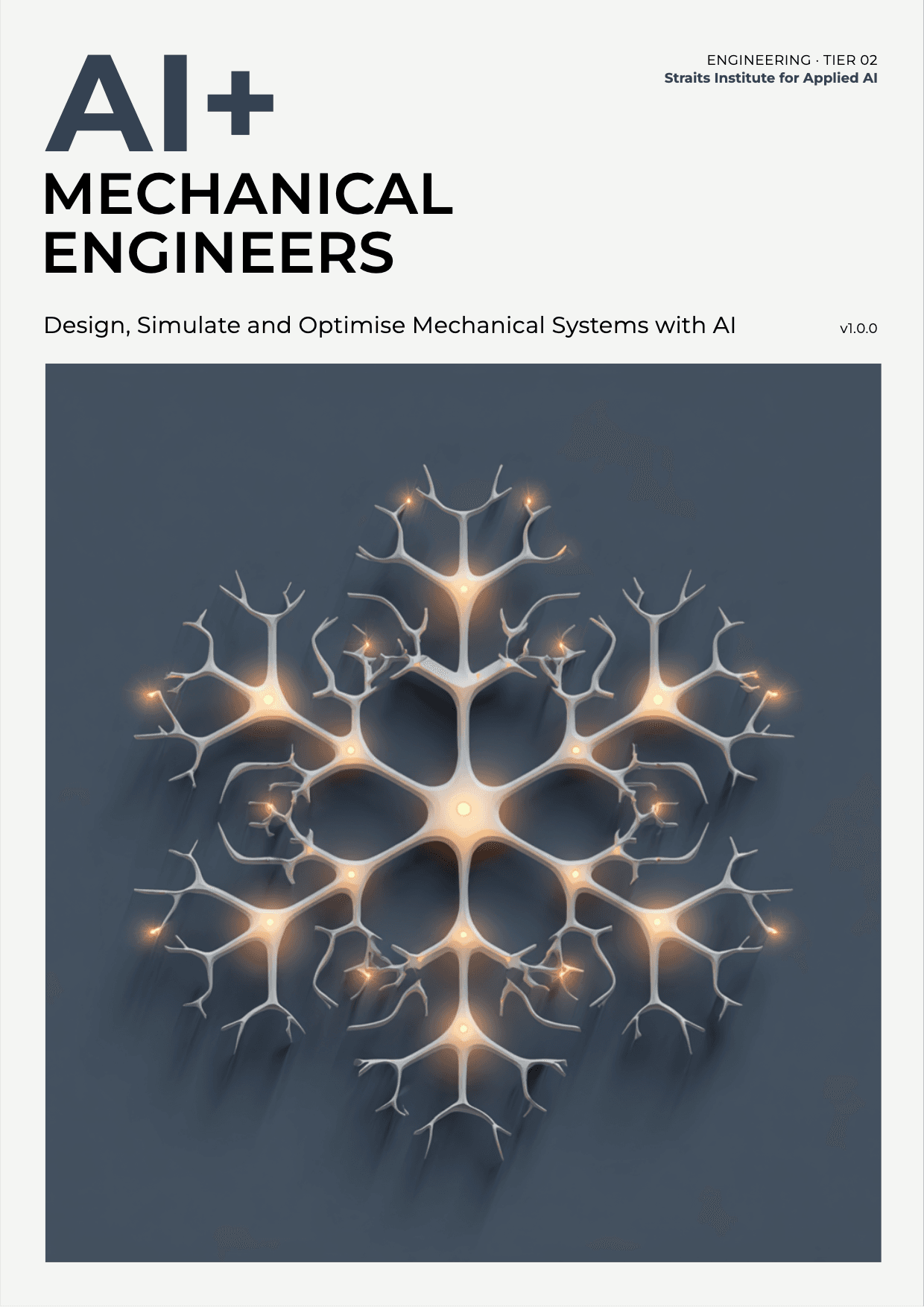
AI+ Mechanical Engineers
Design, Simulate and Optimise Mechanical Systems with AI
Your judgement was never the bottleneck. The paperwork around it was.
You still check every FEA result by hand — but the DFM comment log and the design-alternative memo eat the hours you'd rather spend engineering. This book gives you the SIGN Protocol, the Engineer's Prompt Toolkit, and a 30-day plan for putting AI on the documentation, never the judgement. Built by an AI engineering firm for mechanical engineers who trust their own calculations — and want AI to clear the paperwork out of the way.
Inside
- 15 ready-made prompts: design comparisons, DFM logs, simulation narratives, standards checks, test plans.
- The SIGN Protocol — four checks before any AI touches design, simulation or client project data.
- The Governing Standards Check — catch a superseded materials standard before it costs you.
- The Engineer's Prompt Toolkit — applied to design, thermofluids, manufacturing and machine design practice.
- A 30-day plan — for engineers on the PE, CEng or Pr Eng pathway.
Who this is for
Mechanical engineers across product design, thermofluids, manufacturing/design-for-manufacture, and machine design sub-disciplines — early-to-mid career through senior/chartered (PE, CEng, Pr Eng or equivalent) — working in manufacturing firms, engineering consultancies, product companies, and industrial OEMs
Also for:Mechanical engineering team leads and technical leads who want to understand what AI tools their team is already using; engineering students and new graduates entering product design or manufacturing roles; mechanical engineering faculty designing AI-literacy content for their department
You’ll be able to
- Apply the SIGN Protocol to classify mechanical design and simulation data before using any AI tool; use AI to accelerate generative design exploration and topology optimisation while independently verifying every numerical output; structure FEA/CFD simulation reports and DFM reviews with AI assistance without delegating engineering judgement; draft manufacturing documentation, specifications and technical reports using the Engineer's Prompt Toolkit; evaluate AI-assisted testing and validation data against governing standards; build a 30-day personal AI adoption plan for a mechanical engineering role
What’s inside
- Diagnostic
- How AI-ready is your mechanical engineering practice?
- Chapter 1
- AI in Mechanical Engineering Right Now
- Chapter 2
- How AI Changes Mechanical Engineering Work
- Chapter 3
- AI Safety, Data and the SIGN Protocol
- Chapter 4
- AI for Design and CAD
- Chapter 5
- AI for Simulation and Analysis
- Chapter 6
- AI for Manufacturing and Design for Manufacture
- Chapter 7
- AI for Testing, Validation and Reliability
- Chapter 8
- AI for Documentation, Standards and Project Delivery
- Chapter 9
- AI for Sustainable Design, Lifecycle and Professional Development
- Chapter 10
- Your 30-Day AI Starter Plan for Mechanical Engineering
- Back matter
- Skill Summary · Recommended Next Reads · Glossary · Tool Reference
Will AI replace mechanical engineers?
You still check every FEA result, and that judgement stays with you. AI takes on the documentation: design comparisons, DFM logs, simulation narratives and test plans.
AI+ Mechanical Engineers gives you 15 ready-made prompts, the SIGN Protocol for design and simulation data and the Governing Standards Check for superseded materials standards.
Built by an AI engineering firm for mechanical engineers who trust their own calculations — and want AI to clear the paperwork out of the way.
Part of these packs
Appears in 2 reading paths
Reads well with
Often read alongside this title.
 T2-76 · Job RolesAI+ Engineering Leaders
 T2-31 · Job RolesAI+ Engineers
 T2-142 · Job RolesAI+ Civil Engineers
 T2-144 · Job RolesAI+ Electrical & Electronic Engineers
 T2-145 · Job RolesAI+ Chemical & Process Engineers
 T2-146 · Job RolesAI+ Aerospace Engineers
 T2-147 · Job RolesAI+ Biomedical Engineers
 T2-148 · Job RolesAI+ Materials Engineers