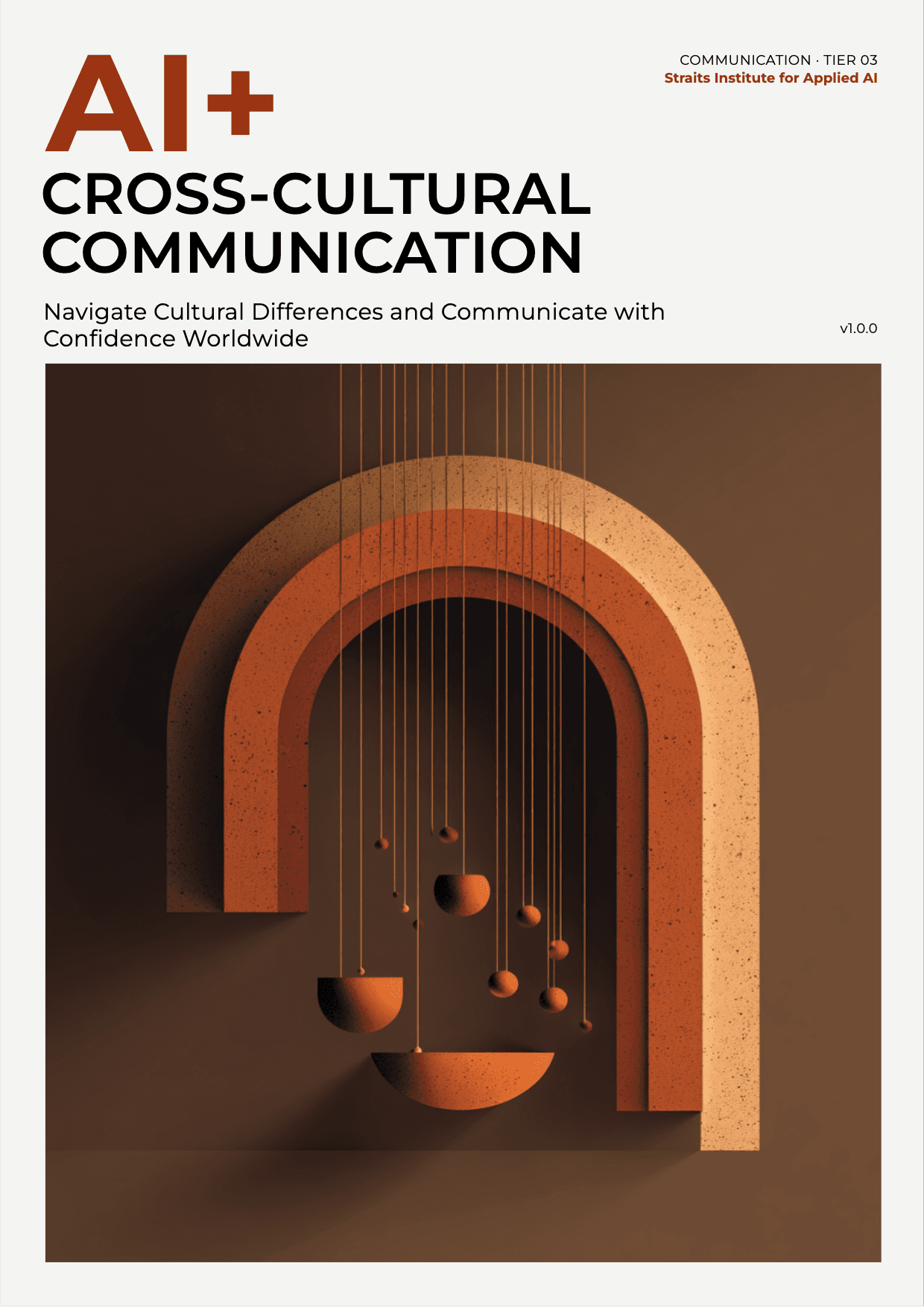
AI+ Cross-Cultural Communication
Navigate Cultural Differences and Communicate with Confidence Worldwide
Your expertise travels further when you know the cultural code.
Your carefully crafted email landed badly. Your meeting ran for an hour and nothing was decided. Your proposal was received warmly — and then went quiet. Cross-cultural communication failures are usually invisible at the moment they happen. AI+ Cross-Cultural Communication gives you the CROSS Framework — a five-step preparation model for any cultural context — plus 26 copy-ready prompts for cultural research, tone calibration, document adaptation, negotiation preparation, and misunderstanding repair. Built by an AI engineering firm for globally active professionals who know their expertise is sound — and want AI to make it travel.
- The CROSS Framework: Context, Register, Outcome, Structure, Signal — the 5-step preparation model for any cultural context, with AI prompts for each step
- The Directness–Formality Matrix: where 12 major professional cultures sit, and the specific communication adjustments each position requires
- 26 ready-made, copy-ready prompts: cultural research, tone calibration, document adaptation, meeting preparation, negotiation briefing, and misunderstanding repair
- Deductive vs inductive structure: the structural logic that determines whether a proposal lands — with before/after rewrites for Germany, Japan, and Nigeria
- The 3-step misunderstanding repair process: Diagnose, Reframe, Re-open — plus 4 worked recovery scenarios across Japan, China, and Brazil
Professionals at any level who regularly communicate across cultural boundaries — whether in global organisations, international client relationships, multinational teams, or cross-border projects. Typically 3–15 years' experience. Has encountered cultural friction in communication but lacks a systematic way to prepare for, adapt to, or recover from it.
Also for:Managers of geographically or culturally diverse teams; HR and L&D professionals building cross-cultural capability; diplomats and civil servants engaging with international counterparts; consultants and advisers working across markets.
- Apply the CROSS Framework to plan and execute any professional communication across cultural boundaries
- Research and interpret cultural communication norms quickly using AI, and calibrate tone, register, and directness accordingly
- Adapt written documents — emails, reports, proposals — for different cultural audiences without losing professional credibility
- Prepare for and navigate cross-cultural meetings, presentations, and negotiations with AI assistance
- Diagnose and repair cross-cultural misunderstandings using a structured repair framework
- Diagnostic
- How AI-ready are you in cross-cultural communication?
- Chapter 1
- The Global Communication Gap
- Chapter 2
- Cultural Intelligence for Professionals
- Chapter 3
- The CROSS Framework
- Chapter 4
- Tone, Register and Directness
- Chapter 5
- Written Communication Across Cultures
- Chapter 6
- Meetings, Presentations and Negotiations
- Chapter 7
- Translation, Localisation and Multilingual Work
- Chapter 8
- Managing Cross-Cultural Misunderstandings
- Chapter 9
- Building Your Cross-Cultural Communication Practice
- Back matter
- Skill Summary · Recommended Next Reads · Glossary · Tool Reference
Built by an AI engineering firm — for globally active professionals whose expertise is sound, and who need it to travel.
Often read alongside this title.
 T3-55 · Job SkillsAI+ Personal Productivity
 T3-23 · Job SkillsAI+ Presentations
 T3-56 · Job SkillsAI+ Meetings
 T3-103 · Job SkillsAI+ Minutes & Action Tracking
 T3-96 · Job SkillsAI+ Scheduling & Calendar Management
 T3-102 · Job SkillsAI+ Workflow & Process Improvement
 T3-67 · Job SkillsAI+ Email and Correspondence
 T1-08 · EssentialsAI+ Communication